(Author’s Note: This article was originally written for the July 2025 Newsletter of Palestine Methodist Church where the author serves as pastor.) .189 batting average for the year. 1 hit in his last 35 at bats (.029 batting average.) That’s how LSU 3rd baseman Michael Braswell III entered the College World Series. Ice cold. Driving the struggle bus. However you want to say it, it was not good.
But instead of criticizing or booing him, LSU fans started a movement on social media to give Braswell a standing ovation when he walked up to the plate for his first at bat in the College World Series. He didn’t get a hit that game, but he made some great plays in the field that contributed to LSU’s two game sweep and eighth National Championship in college baseball. LSU fans continued to cheer for Braswell, and he finally got a hit in the eighth inning of the game in which LSU won the title.
When asked after the game what it meant for the LSU fans “to wrap their arms around him like that”, Braswell replied “It meant the world to me. Those are the moments you dream of. You don’t dream of hitting .180, but you dream of a whole fan base being behind you and supporting you and I couldn’t ask for a better fan base ever.” (Watch Braswell’s entire interview at https://www.youtube.com/shorts/b02iMJN0mnM.)
Encouragement makes a difference. What if we decided to be an encourager instead of a discourager? Upbeat instead of Debbie Downer? As you might guess, the Bible has quite a bit to say about encouragement. 1 Thessalonians 5:11 says “Therefore encourage one another and build each other up, just as in fact you are doing.” Ephesians 4:29 may be even stronger: “Do not let any unwholesome talk come out of your mouths, but only what is helpful for building others up according to their needs, that it may benefit those who listen.” These are only two of the hundreds of verses that encourage us to cling to our faith and to encourage others. The Bible is clear, God intends for us to be encouragers.
A daily devotion I read is titled “The Wake Up Call” published by Seedbed and written by John David Walt, a pastor in the Trinity Conference serving Gillett Methodist Church in Gillett, Arkansas. The theme for this summer’s Wake Up Call is the “Summer of Encouragement” with each devotion designed to encourage and uplift the reader or listener. By the way, you can receive the Wake Up Call for free every day in your email box by subscribing at https://seedbed.com/wakeupcall/. You can listen at the same address or at apple podcasts, spotify, or iheartradio. Just reading or listening to it has encouraged me.
Who do you know that could use a bit of encouragement? How might you do that? Maybe you don’t have to give them a standing ovation, but you can encourage them. Maybe a word, maybe a letter or a text, maybe just a hug. Be an encourager. Because encouragement matters. Just ask Michael Braswell III.
Blackberry Candy. One of the author’s favorite daylilies.
(Author’s note: This article was originally written for the June Newsletter of the Palestine Methodist Church in Ball, LA where the author serves as pastor.) I admit it. I have a flower fixation. I suppose as fixations go, flowers are one of the best. I come by it honestly. My grandfather had a large vegetable garden and grew beautiful roses. My mom and dad grew roses and many other flowers and plants. Since moving, I have planted caladiums and impatiens, hung ferns on the front porch, and built beds for my favorite flower, daylilies.
But it was a lot of time and work. First, I killed the grass and weeds. Then, I cleared the space of competing plants. Tilled the soil. Next, I raked out the grass, weeds, roots, and other impediments to growth. Added improvements (cow manure) to the soil. Placed edging to protect the plants and keep weeds and grass out. Finally, the soil is ready to plant. Now, all I need is time, water, sunshine, and a bit of fertilizer.
Preparation matters. Without proper preparation, the plants stand little chance to grow. With proper preparation, I hope they will thrive. In the secular world, the saying goes “to fail to plan is to plan to fail.” If you were a scout, you know the Scout motto “Be Prepared.” As I was working on my flower beds, I thought, what would happen if I put this much preparation into my spiritual life? Do I put as much preparation into my spiritual life as I put into flowers and plants? As much preparation as I put into my job and career? As much preparation as I put into my fishing trip or hunting trip or other types of recreation?
How can we be spiritually prepared? Do we spend time in God’s Word regularly, perhaps with the help of a devotional book such as the Upper Room, Our Daily Bread, or a number of online devotionals? Do we pray regularly? Do we attend worship on Sunday? Are we a part of a small group such as a Sunday School class? All of these things and more can help us be spiritually prepared for God to grow and move in our lives.
As David prepared to face Goliath the giant, he told King Saul “Your servant has killed both the lion and the bear; this uncircumcised Philistine will be like one of them, because he has defied the armies of the living God.” 1 Samuel 17:36. Did you hear that? David was prepared to face the giant because God had already helped him defeat the lion and the bear. What challenges have you overcome? What lion and bear have you defeated? Perhaps God is preparing you to face a giant.
Preparation matters in the garden, in life, and in our spiritual lives. If we aren’t doing the preparation, then we cannot expect the fruit or the flowers. But when we prepare, we open the door for God to bless us and to help us defeat whatever giants we face.
(Author’s note- This article was written for the May edition of the Palestine Methodist Church newsletter. Find out more about Palestine Methodist Church at http://www.palestinemethodist.org)
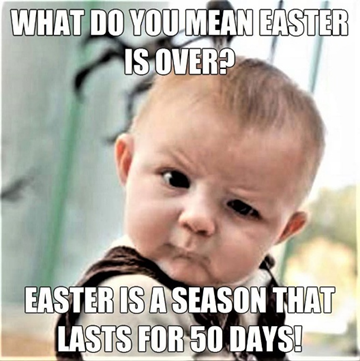
Easter Sunday has come and gone. The Easter baskets (except for the Easter grass- that stuff gets EVERYWHERE) have been put away. The chocolate Easter bunnies have been eaten and whatever Easter candy is left in the stores is likely at least 50% off. The Easter bonnets and fancy Easter dresses and clothes have been shoved to the back of the closet until next year. The Easter Lilies have disappeared from the store shelves. All around us the world says that Easter is over.
But the church clearly says the Easter is not over. Easter in the church is a 50-day season that runs from Easter day to Pentecost. It is the most joyous and celebrative season of the Christian year. The white paraments of Easter day remain on the altar, pulpit, and lectern. We continue to sing the hymns that remind us that Jesus is alive and risen. Easter is the time when we celebrate Jesus’ resurrection, ascension, and the giving of the Holy Spirit. Easter is and should be a reminder to us that we believe daily in a risen and living Lord and Savior, Jesus Christ.
In fact, every Sunday is a “little Easter” when we remember that Jesus is alive. Even during Lent, Sundays are not counted in the 40 day season, because Sundays are feast days, days of celebration, days when we celebrate that Jesus is alive. Thus when you count the days of Lent on the calendar, the number of days is greater than 40, since Sundays are not counted.
What if we remembered every day that Jesus is alive? What if we celebrated his presence with us daily? In Romans 6:9-11, Paul writes “9 For we know that since Christ was raised from the dead, he cannot die again; death no longer has mastery over him. 10 The death he died, he died to sin once for all; but the life he lives, he lives to God. 11 In the same way, count yourselves dead to sin but alive to God in Christ Jesus.” (NIV, emphasis mine) What if we truly lived alive to God in Jesus? How might it change us? How might it change the world?
The next time you see the Easter bunnies and Easter lilies and all the other decorations and reminders of Easter on clearance because Easter Sunday has passed, remember that Easter is not over! We serve a risen and living savior and through his life, death, and resurrection he lives in us! Easter is not over, nor will it ever be, for those who are followers of Jesus. Praise be to God for a living Lord and Savior!
Author’s Note: This article was originally written for the April 2025 Newsletter for Palestine Methodist Church, Ball, LA. To view or receive an electronic copy of our newsletter, please follow us on Facebook at https://www.facebook.com/palgmc or send us an email to palgmc@gmail.com. You can receive a mailed copy of the newsletter by contacting us at (318) 640-9024 or contacting us at palgmc@gmail.com. Thank you for reading!
Before I even came to Palestine, I was told about how friendly this church is. I have already discovered for myself that you are one of the friendliest churches I have served. Being friendly is great, it is wonderful, it is necessary. But are we hospitable?
What is the difference between being friendly and being hospitable? Boy, I am glad you asked! Being friendly is building relationships with people we already know and love, i.e. friends and family. Hospitality is being welcoming to and building relationships with people we don’t know, i.e. strangers. Many churches are friendly, fewer are truly hospitable.
Why should we be hospitable and intentionally build relationships with people we don’t know? We are all children of God. What if we treated every person we met as a precious, valued, child of God? How might it change us? How might it change the world?
When we are hospitable, we never know with whom we might be interacting . The final chapter of the book of Hebrews is subtitled “Concluding Exhortations” in my Bible. It contains several short pieces of advice to the reader including this one in Hebrews 13:2 “Do not forget to show hospitality to strangers, for by so doing some people have shown hospitality to angels without knowing it.” When we show hospitality to strangers, we never know with whom we are interacting. What if we treated every stranger we met as an angel? How might it change us? How might it change the world?
How can we become a more hospitable (not just friendly) church? Again, I’m glad you asked and here’s a few ideas: (1) Practice the rule of ten. The rule of ten is that you greet everyone within ten feet of you, whether you have never met them or have known then for many years. Using the rule of ten almost assures that everyone is greeted at least once. (2) Practice the rule of three. Statistics say that guests are usually the first to leave, usually within the first three minutes. The rule of three states that you spend the first three minutes after service intentionally looking for guests before speaking to people you already know. (3) Be a first friend. A first friend intentionally watches for new guests, people attending for the first time, greets them, builds a relationship with them, maybe sits with them, introduces them to other people and invites them back to church.
Being friendly is a great start. It is not an ending point. Our call as followers of Jesus is to be hospitable and welcoming not only to people we know, but to strangers and people we don’t know. My prayer is that Palestine would not only be the friendliest church in the area, but also the most hospitable to any child of God who attends our services or walks in our doors.
Audio version of my message from September 15, 2024. Comtinuation of a message series on the mission statement of the Global Methodist Church. Message title “Worship Passionately” from Psalm 150:1-6.
Audio version of my message from September 8, 2024. First in a series of messages about the mission statement of the Global Methodist Church. Message title “Our Mission: Make Disciples of Jesus Christ” from Matthew 16:21-28. Sorry about the coughing. The frog jumped into my throat, but I got through it!
On Sunday, August 4, I preached on one of my least favorite scriptures. To be clear, there are many scriptures that I don’t “like.” I don’t like it when Jesus says I should love my enemy and pray for those who persecute me (Matthew 5:44). I don’t like it when Jesus says to forgive not seven times but seventy times seven (Matthew 18:21-22). These are only a few of the Bible passages that I dislike and make me uncomfortable.
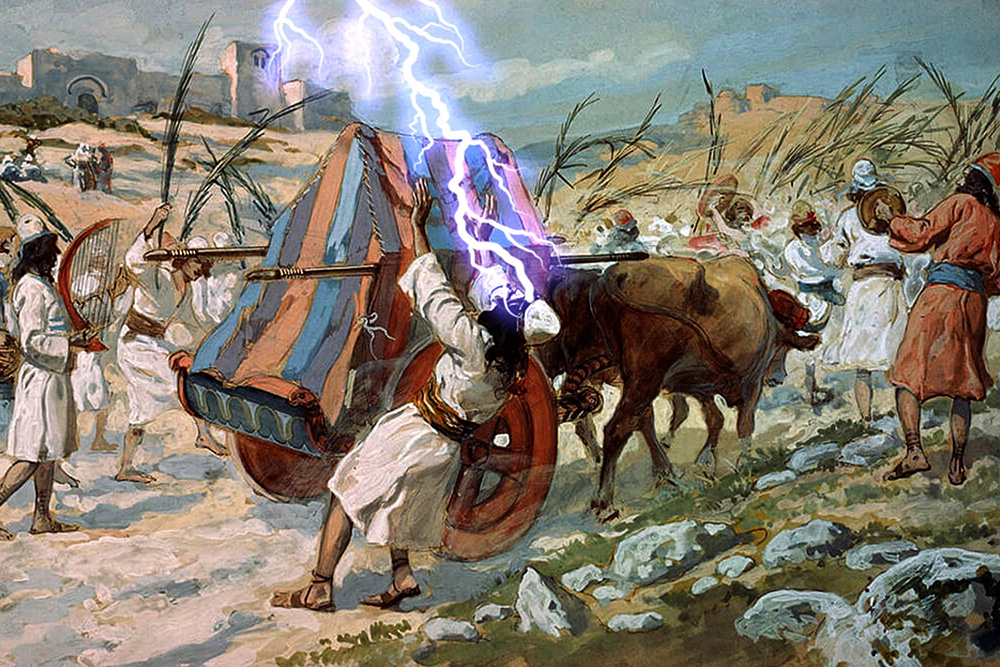
In 2 Samuel 6, David has united the tribes of Israel, conquered Jerusalem, and built his palace. Only one thing remains: to move the Ark of the Covenant to Jerusalem. 1 Samuel 5 records that the ark was lost to the enemy Philistines but wherever it went plague and trouble followed. So the Philistines sent it back to the Israelites in 1 Samuel 6 on a new cart pulled by oxen. After some of the inhabitants of Beth Shemesh died after looking inside the ark (6:19-20), the ark ended up in Kiriath Jiriam. Apparently, it stayed there until David decides to move it to Jerusalem.
Like when it was received from the Philistines, the ark was placed on a new cart pulled by oxen, accompanied by Uzzah and Ahio, sons of Abinadab. All goes fine until the threshing floor of Nakon when the oxen stumble, Uzzah reaches out to steady the ark, and is instantly killed. Not fair, I want to say. He was just trying to help, I tell God. We may not like it, but maybe we can learn from it.
One of the things that we can learn is that obedience matters. In Exodus 25:14-15 and Deuteronomy 10:8 we see that the ark was equipped with poles to be carried on the shoulders of the Levites. Numbers 7:9 adds that this group of Levites, the sons of Kohath, would not use carts “because theirs was the service of the holy things, which they carried on their shoulders.” And, while carrying the holy things, God clearly warned the Levites that “they shall not touch any holy thing, lest they die” (Numbers 4:15, emphasis added). Both David and Uzzah forgot or disregarded these instructions. When we ignore, forget, disregard, or are ignorant of God’s instruction, we do so at our own peril.
We can also learn that good intentions are not enough. 2 Samuel 6 tells us that the oxen stumble and Uzzah touches the ark to steady it. Uzzah’s intentions were good when he reached out to touch the ark, he was trying to help the ark, and not harm it. But maybe he was enthralled with the dancing, singing, music, and the joy of moving the ark, or maybe he was ignorant of the danger, but, for whatever reason, he touched the ark and suffered the consequences. Good intentions are not enough.
We should also learn that things of God are serious business- they are holy. The word holy means “set apart”. The things and worship of God are “set apart” to specifically focus our minds on God. We need to ask God’s forgiveness (not the preacher’s forgiveness) when we come to worship and our minds are on the week that was or on the week that is coming. Or when we are distracted when we read the Bible or pray. We need to ask God’s forgiveness when we are thinking about what is for lunch, or the Olympics, or writing notes to our friends, or taking a nap instead of the things of God. God gives us 7 days, 24 hours per day, 168 hours in a week to do all that. Can we not give God some of those hours? The things of God, our relationship with God, is, and should be, serious business.
Honestly, 2 Samuel 6 and the story of Uzzah is one of my least favorite scriptures. But even this least favorite scripture has truths to teach us if we pay attention.
(Author’s Note: I have been preaching a message series from 1 Samuel during the summer of 2024 at Grace Methodist Church of Ruston. This article is an excerpt from the June 23, 2024 message)
1 Samuel 16:7 makes the telling point that inward qualities are more important than outward ones. “The Lord said to Samuel, “Do not look on his appearance or on the height of his stature, because I have rejected him; for the Lord sees not as a man sees; man looks on the outward appearance, but the Lord looks on the heart.”
There’s an old saying: “You never get a second chance to make a good first impression.” And that’s too bad, because first impressions generally do not reveal inward qualities. The anointing of David demonstrates to us that we are to look deeper into each other than to see only what’s on the surface. As Jesse presented his sons to the prophet, Samuel thought ““Surely the Lord’s anointed stands here before the Lord.” (16:6) “But the Lord said to Samuel, “Do not consider his appearance or his height, for I have rejected him. The Lord does not look at the things people look at. People look at the outward appearance, but the Lord looks at the heart.” (16:7)
I can only imagine Samuel’s confusion as the last son was presented and God said “no, not him”. He turned to Jesse and said, “Is this all?” There was one more son; he was out in the fields taking care of the sheep. Notice that Jesse hadn’t even thought to bring him in. He certainly wasn’t king material. His dad and brothers knew that. But Samuel was insistent and so he was brought into the house and suddenly this young nobody became somebody.
It’s hard for us to understand exactly why David would have been such an unlikely candidate for king, but let me give you three reasons to help paint the picture. First of all, David had an undistinguished family tree. His grandmother was an immigrant and among his ancestors was a woman almost executed for adultery and a prostitute. What kind of kingly lineage was that? His bloodline just wasn’t right. The second thing that made him such an unlikely candidate was that he was in the wrong place in the birth order. He was the youngest son. How many are youngest children? You know what it’s like to live in the shadow of your older siblings.
In David’s day and age your birth order determined your lot in life. The youngest child had a very unlikely prospect for success. The oldest son when he was of age would begin working with his father on the farm as soon as he was old enough to help or tend the sheep. But, when the next oldest son became old enough to help, the older son might leave home to start his own farm, learn a trade, or get married. He could decide to stay on the farm or not. This succession would continue until the last son would ultimately become the family’s shepherd and farm hand because there was no one to come behind him to replace him. David’s place in life was already determined. He had a job and apparently was good at that job from what we’re told later on in his life.
The fact is if we had been living in the farmhouse next door to David’s family on the Judean hillside, we may not have even known the name of David’s youngest son. His dad didn’t even think of including him until Samuel asked him if there were any more. Jesse rubbed his beard and said, “Oh, yeah, there’s my youngest. Almost forgot about him.” So fathers, don’t forget to present all your sons when the prophet comes to visit.
Samuel was so in tune with God that he listened to His will in selecting David to be anointed as king. And, arguably, David was Israel’s greatest king. The story of David is a story of right seeing. It’s a story which challenges us to look beyond outward appearances to a person’s heart and character. God saw something in David that no one else had seen. The Hebrew word that is used in the text to describe how Samuel looked at Jesse’s sons implies that he looked but didn’t really see. Inward qualities are more important than outward.
Aerial view of the entrance to Grace Methodist Church from Google Maps.
Grace Methodist Church in Ruston is near the northernmost city limit of the city of Ruston, on US 167/63, one of the major north-south thoroughfares in the state of Louisiana. After moving to Grace in July of 2021, I noticed many northbound cars would turn from the five lane road (two northbound lanes, center turn lane, and two southbound lanes) into our driveway. “Oh, that’s nice”, I thought, “I wonder who is coming to visit us at Grace?” But most of the cars would soon make a U turn, turn around, and head back to the south, hopefully to find the turn that they presumably missed. At first, I was a bit miffed that so many people would (a) miss the chance to visit us at Grace and (b) increase the traffic turning in our church. But as I thought about it further, what better place for a U turn than the church? After all, God has been in the U turn business for many years.
Think about all the lives that faith in God has turned around. The Bible gives us numerous examples. Abraham lied not once, but twice, (Genesis 12 and 20) about his wife being his sister and both times were nearly disastrous. David was an adulterer and murderer, yet a “man after God’s own heart”(Acts 13:2) and perhaps Israel’s greatest king. Then there was a fellow named Saul, who met Jesus on the road to Damascus (Acts 9) and experienced a conversion experience so life changing that he went from persecuting the followers of Jesus to one of the greatest evangelists the world has ever known. He went on to write twenty eight percent of the entire New Testament!* The list of unlikely people used by God could go on and on. God has a habit of using unworthy and unlikely people, people like you and me.
In Mark chapter 1, we meet a strange character who wore camel’s hair and ate locusts and wild honey by the name of John. Most of us know him as John the Baptist today. Because that’s what he was doing when we meet him in Mark! He was baptizing people in the Jordan river and telling them that one greater than he was coming. Mark even baptized Jesus himself! (Mark 1:9-11). After his baptism and temptation, Mark records Jesus’ first message in Mark 1:15 as “’The time has come,’ he said. ‘The kingdom of God has come near. Repent and believe the good news!’”
The Greek word for “repent” in Mark 1:15 is metanoeite, the second person plural of the Greek verb metanoia. Meta means change (think of the English word metamorphosis) and noia means mind (think of the English word knowledge). Metonoia literally means to “change the mind.” It is the same word used in the military of the day to indicate an about face, a 180 degree turning around, a U turn.
So, if there is anywhere in the world that allows a U turn it should be the church. Repent (make a u turn) and believe was among Jesus’ first message. It is still true today. Repent and believe. Maybe you and I need to make a U turn in life. Maybe we need to turn away from some things and turn toward following Jesus. The good news is that U turns are always allowed for followers of Jesus Christ and in His church. And if you need to make a U turn on US 167 on the north side of Ruston, U turns for cars and lives are allowed at Grace Methodist Church in Ruston!
After much soul searching, prayer, and a few sleepless nights, I have decided to turn in my UMC Clergy credentials and leave the United Methodist Church. Here’s why. (Note: This has been a very difficult decision with sleepless nights and lots of prayer. It was not made quickly nor lightly. Unkind and disparaging comments will be deleted.)
I have served as a full-time United Methodist pastor since June of 1999. That’s 24 years of my life. I have served 10 churches as a full time clergy person in the Louisiana Annual Conference in 6 appointments. During those years, I have preached sermons, led Bible Studies, taught confirmation classes, officiated at funerals and weddings, attended many committee meetings, planned events and worship services, baptized adults, youth and children, officiated at the communion table, led people to take vows of loyalty to the UMC and their local churches, taught the faith to youth and children and so many more. I have enjoyed and found fulfillment in my life as a UMC pastor. I have been blessed and I know it. What I have never done as a UMC clergy person is vote in clergy session at annual conference, vote on constitutional amendments in the UMC, only voted once for General and Jurisdictional Conference delegates that represent me, or been considered for “choice” appointments in my annual conference such as large churches or a superintendent’s role. Why? Because I am not a full elder. I have served the UMC as an Other Fellowship member, Full Time Local Pastor, and Associate Member. None of which have full voting rights. So, I have taught confirmation to UMC youth, baptized people into the UMC, officiated at weddings and funerals for faithful UMC members, but I sit on the side during Clergy sessions of the Annual Conference without a vote where I am told I am there “only as a courtesy.” This despite the fact that I have the same degree (Masters of Divinity) as many full elders, but my degree, while from a fully accredited seminary, is from a non United Methodist senate approved school. How long will the UMC continue to overlook this social justice issue in its own system? Faithful UMC pastors of all varieties deserve a full seat at the table. I have decided to leave the UMC because I want to be fully included and have a full voice and vote.
A second reason I have decided to leave the UMC is that it has broken its own rules and doctrines. I grew up in a denomination that had a congregational system. That meant that even though the sign on the outside had the same name, each congregation could practice drastically different things. Some practiced open communion, others closed. Some allowed female pastors and leaders, others did not. Church constitutions and bylaws varied greatly from congregation to congregation. I loved that the UMC had one Book of Discipline to govern all of its denomination, clergy, and congregations, from the largest to the smallest. I knew that every UMC church was playing by the same rules. I knew that every congregation I served as a UMC Clergy would have a Committee on Lay Leadership, Finance Committee, Trustees Committee and Staff Parish Relations Committee. Why? Because these committees are mandated by the UMC Book of Discipline. Another thing mandated by the Book of Discipline are the vows UMC elders take including “6. Do you know the General Rules of our Church? 7. Will you keep them? 8. Have you studied the doctrines of The United Methodist Church? 9. After full examination, do you believe that our doctrines are in harmony with the Holy Scriptures? 10. Will you preach and maintain them? 11. Have you studied our form of Church discipline and polity? 12. Do you approve our Church government and polity? 13. Will you support and maintain them?” Yet, there are some, albeit a relative few, who have decided not to keep the vows they have willingly taken. To me, as one has moved from one denomination to another, if you do not agree with the theological position of the denomination where you are, you can go to another that more closely fits what you believe. I did. I believe, and still do, that women are as capable pastors as men. I believe that the Bible is the Holy Word of God, but it was written in another place and time and should not be interpreted literally. Yet, many in the UMC are instead seeking to change the long held principles and beliefs of a majority of the denomination, or, even worse in my opinion, they are ignoring them and violating the vows they have taken. There are proper channels to change the doctrines and discipline of the UMC. But when those have failed, some have placed themselves above what the church has said it believes and how we should act as followers of Jesus without repercussion. The UMC has become the Wild West where our doctrines and discipline mean little and we are reliving the days of the Judges when “everyone did as they saw fit” (Judges 17:4 NLT). The breaking of our vows and the intentional violation of our rules without repercussion is another reason I have decided to leave the UMC.
A third reason I have decided to leave the UMC is that the itinerant, or appointment system of clergy, is broken. As one guaranteed an appointment in the UMC, that comes with a caveat. It means I could be moved anywhere within the conference. I do have freedom to accept or decline that appointment, and I have said no to an appointment in the past, but I also know that to do so could have repercussions for me personally and professionally. The itinerant system worked OK (for the most part) when the clergy person, usually a male, was single or the wife was a homemaker and did not work outside the home and every church had a parsonage. (That is not to minimize the importance or hard work involved in being a stay at home mom or even dad- those roles are difficult and vital.) Today, it is rare for the spouse of the clergy person to not work outside of the home. Accepting a new appointment means packing up, moving to a new city, and my spouse having to find a new job at who knows what salary level. While we don’t have children, children moving schools, making new friends, and all the other factors such as finding new doctors and dentists and hair dressers only complicate the itineracy process. All parsonages are not created equal. We have been blessed to live in some nice homes in nice neighborhoods. But we have also lived in some not-so-well maintained homes in not-so-nice neighborhoods. While itineracy may have worked ok in the past, I think its day has come and gone and a new way of making appointments needs to take its place.
While the UMC was once of the largest denominations, it has experienced rapid decline, especially in the United States. We have seen that in Louisiana. This table from http://www.umdata.org/Default.aspx shows that in less than 10 years (from 2012-2021) membership in the Louisiana Conference has declined from over 120,935 to 102,823. That’s a loss of 18,112 persons or 15% of members in less than 10 years. Attendance has declined from 41,185 to 19,942, 21,243 people less or a 52% loss in 10 years. When I came into the Louisiana Conference in 1999 there were over 500 churches. Today through closure, disaffiliation, or merger this 2023 appointment list here https://louisiana.brtapp.com/files/appointments/appointments+-+as+of+jan.+1%2c+2023+(edit+for+website).pdf shows there are only 383 UMC churches in Louisiana. A net loss of over 100 churches in only 24 years. That does not count the 68 churches that disaffiliated in 2022 or the 95 that disaffiliated in 2023. Are there many reasons for this? Yes. Communities change, a hurricane changes the landscape forever, people move away and don’t return, a worldwide pandemic and so many others. But there are people in each of those communities who need to know Jesus and who are not in church on a Sunday morning. I fear that United Methodism has lost its original Wesleyan purpose to “spread scriptural holiness across the land” and its evangelistic zeal to share the good news of Jesus with others. Of the appointments I have served, mostly in rural communities and small towns, only 1 has experienced growth. Most, like many churches in the UMC, have seen, at best, plateaued attendance, or decline. Yes, that likely says something about me as a pastor. It says something about the churches I have served and the communities in which they are located. Instead of “keeping the main thing the main thing” as one Bishop who served Louisiana said, we have lost our way and watched while our churches and denomination continues its decline.
You may have noticed that I have not mentioned the “H” word. I want my homosexual friends and family to know first of all that I love them and that I believe God loves them also. You are welcome at my house, at my table, and, my prayer is, that you will be welcomed at the churches I serve. I am a traditionalist, but not that kind of traditionalist. I believe homosexuality to be sin, but I also know I am a sinner in need of God’s grace. I believe all of us to be in the same boat- sinners in need of the saving grace of Jesus Christ. I also believe that, despite protestations to the contrary, there will be little place for traditionalists in the post-separation/post-splinter UMC. I actually hope I am wrong about this. One of the things that attracted me to the UMC was the idea that we didn’t have to agree on everything to agree on the most important things. I know I am often wrong. It’s part of my broken human condition. The Bible calls it sin. I know what an emotional issue this is for me and for many. I can see both sides. I agree with those who say this is not the only issue that is “incompatible with scripture.” I know my own sin and know that they are just as “incompatible with scripture.” I also agree with those who say there is no support for a homosexual lifestyle in scripture. At least there is none that I can find. For many years I have tried and have been able with some success to stand in the middle. But now it seems that there is no place to stand in the middle. Sides must be chosen. And to be known as a traditionalist in a post separation UMC, could be a very difficult place to be. I hope the UMC will prove me wrong on this account also.
I am grateful for the churches I have served, the friends and colleagues who have supported me throughout the years. I don’t wish ill for the UMC. Actually, I hope and pray that the UMC will thrive. But, right now, I believe God is calling me to leave the United Methodist Church and take a different direction. For all these reasons and more, I have made the difficult decision to leave the UMC.








 revkevreflections