A Prescription for Salvation

numbers-bronze20snake

(Author’s note: this is the introduction to my sermon on March 11, 2018 “A Prescription for Salvation” from Numbers 21:4-9 at First United Methodist Church Winnfield, LA)

A guide at Blarney Castle in Ireland was explaining to some visitors that his job was not always as pleasant as it seemed. He told them about a group of disgruntled tourists he had taken to the castle earlier in the week. “These people were complaining about everything,” he said. “They didn’t like the weather, the food, their hotel accommodations, the prices, everything. Then to top it off, when we arrived at the castle, we found that the area around the Blarney Stone was roped off. Workmen were making some kind of repairs.” “This is the last straw!” exclaimed one lady who seemed to be the chief faultfinder in the group. “I’ve come all this way, and now I can’t even kiss the Blarney Stone.”

“Well, you know,” the guide said, “according to legend, if you kiss someone who has kissed the stone, it’s the same as kissing the stone itself.” “And I suppose you’ve kissed the stone,” said the exasperated lady. “Better than that.” replied the guide. “I’ve sat on it and you’re more than welcome to kiss me there.”

Last Sunday we left the people of Israel at Mount Sinai where they had received the commandments of God. They spent about a year at this holy mountain. (They arrived at Sinai in Exodus 19:1; they did not break camp until Numbers 10:11.)  In today’s text, the people of Israel are like those complaining tourists.  In our text for today, they are on the move again through the wilderness. God had graciously provided for their needs with manna in the morning, but all they had was an attitude: “We detest this miserable food” (v. 5)! It was manna, heavenly food, but they were tired of it. We don’t really know what “manna” means. Some scholars say that the word “manna” came from the word meaning “what is this”, others say it comes from the word “to despise,” so that the very name of the daily provision from the hand of God was being mocked every time they gathered it in the morning.

Because of their complaining, God infected them with a plague of poisonous snakes. This is a strange and maybe even repulsive story to us. This story still has meaning for us because the Israelites are not any different from us, and I believe God teaches us a three-part lesson through this experience of the children of Israel: first, their discontent (vv. 4-6); second, their petition. (vv. 6-7); third, God’s prescription (vv. 8-9).

Rules for Living

exodus 20_1-17(Author’s note:  this is the conclusion of my message on March 4, 2018 at FUMC Winnfield from Exodus 20:1-17 titled “Rules for Living”)

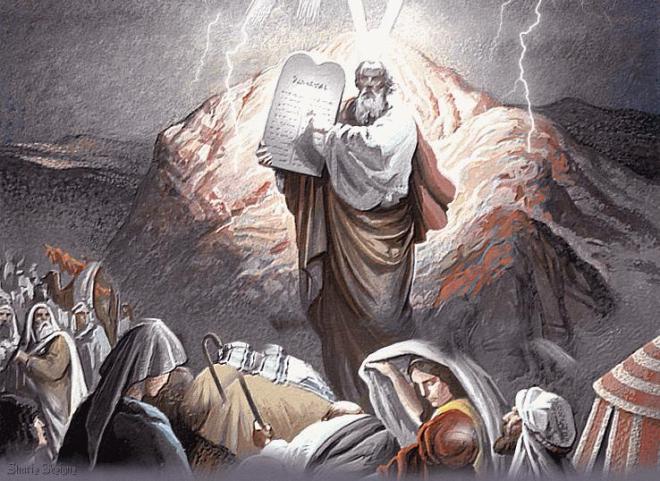
We live in a world that is changing more rapidly than ever before. We live in a world where old standards of morality are being questioned. Into this world of upheaval and change, the Ten Commandments still ring true. Thousands of years have come and gone since Moses came down from Mount Sinai. The Ten Commandments provide a series of rules and ethics for life. These Ten Commandments have not budged one inch in calling men and women to the same ethical standards of life. Times may have changed, but the principles of these Ten Commandments are eternally the same.

Lloyd Douglas told how he loved to visit a little old man who gave violin lessons. He had a studio, a small room in a row of rooms where other music teachers taught. One morning he walked in and by way of greeting, said, ‘Well, what’s the good news for today?’ ” Putting down his violin, stepping over to his tuning fork suspended from a silk thread, the violin teacher struck it a sharp blow with a padded mallet, and said, “There is the good news for today. That, my friend, is ‘A.’ It was ‘A’ all day yesterday … it will be ‘A’ all day tomorrow, next week, and for a thousand years … the soprano upstairs warbles off-key … the tenor next door flats his high ones … the piano across the hall is out of tune … noise all around me, noise … noise … noise; but that, my friend, is ‘A.’ and it always will be.”

Some things remain constant in the midst of noise and change. Some things, like the Ten Commandments, are timeless and permanent! You can come back to them and confidently follow them with your life. They are rules or guidelines for living that come to us from God. Are you following his guidelines for living?

Keeping the Ten Commandments requires some deep commitments. But there is one thing more to be said. THE TEN COMMANDMENTS ARE NOT ENOUGH by themselves.  The Ten Commandments are wonderful, they’re essential, they simply are inadequate.

8 of the 10 tell us how not to live, not how to live. When Jesus was asked to cite the greatest commandment, he did not mention any of the Ten Commandments. He cited a law greater than all the commandments put together. “You shall love the Lord your God with all your heart and with all your soul and with all your mind . . . and your neighbor as yourself.” (Luke 10:27)

Notice that these 10 commandments have 2 main components. The first four commandments focus on your relationship with God- they have a vertical focus. The last 6 commandments focus on our relationship with each other- they have a horizontal focus. Put both the horizontal and vertical components together and they make a cross. Similar to the one Jesus gave his life upon.

The Ten Commandments are great, but they are not enough. What is needed is to add to these laws the love of Jesus. That is why Jesus said that he had not come to destroy the Law but to fulfill it. To fill it full of love. The rules for living- they show us how to relate to God, how to relate to others, and steady us in a changing world. But Jesus lived, died, and lived again to show us how live them out in everyday life. Whose rules for living are you following?

Sacrifice for the Good of All

Sacrifice for the Good of All

(Author’s note: This article was originally published in the March 2018 FUMC Winnfield Newsletter “The Cross and Tower.”  The entire newsletter can be accessed at www.fumcwinnfield.com)

lsu baseball logo

It’s that time of year again! The crack of the bat! The ball hitting leather! Stand for the national anthem, then the umpire says “play ball” and the baseball or softball game begins. At the writing of this article, I have just watched Winnfield Senior High’s first baseball game of the year, opening weekend for the LSU Tigers, and am anxiously awaiting to see if my favorite Major League team, the Houston Astros, can become the first World Series repeat champions since 2000. Yes, it is time for the rite of spring, America’s game, baseball and softball.

This game that is often called “America’s pastime” contains something unique. It is an idea that carries over into the life of the church and especially applies to us during Lent, that spring season when we prepare our hearts and lives for the death and resurrection of Jesus. The idea that bridges faith with baseball and softball is sacrifice.

In baseball and softball, a sacrifice occurs when a batter voluntarily makes an out for the good of his or her team. Often, this is done to move a runner to the next base or even to score a run for the team through a sacrifice bunt or a sacrifice fly ball.


sacrifice cross

In faith, a sacrifice is an animal or person who gives his life for the good of all. In the Old Testament, this was done through the shedding of blood of animals. In the New Testament, one man, Jesus Christ, gave his life so that we might have life. 1 John 2:2 says “He (Jesus) is the atoning sacrifice for our sins, and not only for ours but also for the sins of the whole world.” (NIV)

I am thankful for baseball and softball. Not only because I enjoy watching it, enjoy watching the children and youth of our church play, enjoy being outside,  but because it keeps this word “sacrifice” in our vocabulary. Think about it. When is the last time you used the word “sacrifice” outside of a baseball/softball or faith context? When is the last time you thought about what it means to make a sacrifice and what it costs? The haunting question that comes back to us is what have we sacrificed for the good of others, for our team, for our faith. The truth is that we don’t really like to sacrifice our wants, our desires, our at bat, for the good of others. But that is exactly what the batter is asked to do. That is exactly what Jesus did.


The next time you watch a baseball or softball game and a player makes a sacrifice for the good of the team, I hope you’ll think of Jesus, who sacrificed himself for the good of all

Questions to ponder:  Are you a baseball/softball fan?  Why or why not? When is the last time you mentioned sacrifice outside of a baseball/softball or faith context?  What have we sacrificed for the good of our team or our faith?

The Divine Deal

The Divine Deal

(Author’s note: this is the conclusion of my message “The Divine Deal” Genesis 17:1-9, 15-21 from Sunday, February 25, 2018 at FUMC Winnfield)

let's make a dealWhen I was a kid I loved holidays and summer.  Not just because I was out of school, but because I was home in the morning to watch TV game shows.  That was before many game shows were on at night, before there was such a thing as the game show network.  I got to watch the Price is Right, Card Sharks, Press your luck (with those crazy “Whammies”), the $20,000 pyramid and one of my favorites, Let’s Make a Deal.  One of the reasons I liked Let’s Make a Deal is that the audience dressed up as all kind of crazy things.

The basic concept behind Let’s Make a Deal (which is still on today led by comedian Wayne Brady and airs on our CBS affiliate each weekday at 2 PM) is that the contestant gets to choose between several items hoping to trade up for something better.  My favorite part of the show was the big deal of the day at the end, where the winningest contestant got to choose among one of three doors, as long as they were willing to give up what they had already won.  One door would be a bust, one would be ok, and the other would be spectacular.  Sometimes they won, many times they did not win the big deal.

          God offered Abraham and Sarah, and us, the big deal.  And fortunately for us there are not three doors, one of which is a loser, the other is so-so, and only one is the big deal of the day.  But God offers us the big deal, the best deal, if we will take it.  Now like on the TV show, it entails us giving something up.  Maybe our wants, our desires, our dreams, our selfishness to follow God.   Abraham and Sarah did as God commanded and God rewarded them far beyond their wildest dreams. Not as quickly as they might have thought for God’s timetable is not our timetable.  But God rewarded them far beyond anything they could ever have imagined.  God’s covenant offered them a better plan, the best plan and they followed it.  God has been faithful to his promises and covenant, have we?   Abraham and Sarah said yes to the divine deal, and their lives were never the same.  God is still offering us the Divine Deal today- what will we say?

Take Time to Fish Between the Cracks

toledo bend 3

Sunset from Sunset Marina on Toledo Bend near Many, Louisiana.

Bloggers Note:  Every week there are stories and information that I want to tell in my message but there is simply not enough time.  My message this past Sunday “Going Fishing” from Mark 1:14-20 was like that. This story by Terry Higginbotham was left on the cutting room floor.  But it is worth the read.  Please note: this is not my work.  The original author is Terry Higginbotham copyright 2004.


The summer of 1972, my brother and I were filling cricket and bait buckets for Mr. K.C. Bray at the Sunset Marina on the Toledo Bend Reservoir just south of Many, Louisiana.

It was just another hot, humid, July in the southwest Louisiana. Each day the same as yesterday and with almost certainty the same as it would be tomorrow. The wind was so still that the Spanish moss barely rustled in the old cypress trees. But these were the type of days I liked, cause the fishing would be good. Good fishing meant good tips.

Lil’ Brother and I never did make a lot of money, but enough to keep us just short of even on our account at Mr. K.C.`s store. Our daily provisions consisted of two cokes, a moon pie, a Miss. Dailey’s fresh made sandwich, and all the crickets we needed to catch our supper. By 7:00 p.m., every evening we would have our 3 bream apiece. We would gut `em, stick `em, and cook `em over a little fire we would make on the bank near our tent.

Lil’ Brother and I had spent the last two summers camping on the banks of the Bend. We fancied ourselves as a modern day Tom Sawyer and Huck Finn. We were accountable to no one and responsible for only our daily bread. Don’t get me wrong, we were not bad kids nor did we come from a broken home. We had loving parents, grandparents, and friends. We were just lucky enough to grow up in a part of the world and in a time that allowed us to live free, truly free.

Our parents would come to the Bend on the weekends and we would get a reprieve from our day-to-day attempts to “survive”. We didn’t know until years later that mom and dad gave Mr. K.C. money to cover our supper in the case fishing ever went bad. They would bring us fresh clothes, comic books, candy, and fresh tackle for our nightly fishing. They would stay for the weekend then head for real world late on Sunday Evening.

On Friday night we would all go down to the dock. We would sit for hours talking about the week’s events. Lil Brother and I would tell about our adventures. Dad would tell us stories about the jobs he was on. Dad was an ironworker and we were fascinated by his stories of “walking in the air”. To us he was a superhero. Saturday we would spend the day fishing, swimming, and skiing.

Sunday morning was spent at “church”. We would go down to the dock, bait a couple of hand lines. We would then lower the hand lines through the cracks in the dock. The really big fish would rest in the shade, just under the dock. The best way to get to them was to fish through the cracks where the two floating partitions of the dock joined. While Lil’ Brother and I would fish for the Big Ones, Daddy would read to us about becoming “Fishers of Men”. Some of the best times of my life were spent belly down on that old dock, coaxing those big bluegills out with worms and crickets. As I look back on it now, it wasn’t because of the fishing but because of the time spent with Dad and Lil’ Brother.

Recently my dad came to visit. I was in the midst of a major project and wasn’t spending much time with him. Maybe a few minutes in the morning and an hour or so at night, before I passed out from exhaustion. On his last night, I finally got to tell him about the new boat I just bought. About the rods and reels, tackle, and accessories just waiting until we got a chance to go fishing. I told him about the cabin on Toledo Bend that we were going to rent, as soon as I got enough time to go. I told him about how excited the kids were when I had brought home new rods and reels for them, last month. He seemed to enjoy the talk although he seemed very quiet and almost sad.

My dad left that next morning. As we shook hands, he drew me near and presented me with an old box. He whispered, “The secrets to a happy life are in here”. Dad was always a little strange when it came to good-byes, so I just smiled, waved and watched him slowly drive out of sight.

The small box was worn red with a small picture of a man battling a giant bass. Below the picture was the caption “Sunset Marina Toledo Bend Many, Louisiana”. I slowly opened the box and smiled as I became aware of its contents. Truly these were the “secrets of life”. In the box was a small bible with a bookmark with Matthew 4:19 printed on it. It had been a while but I did remember, “Follow Me and I will make you Fishers of Men”. Beside the Bible was a small hand line wrapped in a piece of paper with my dad’s handwriting scrawled on it. I unfolded the note and smiled as I read the simple key to a happy life.

“Son, Make time to fish through the cracks”.

Today isn’t just another hot, humid, July day in southwest Louisiana. Not quite the same as yesterday and with almost certainty the same as it will be tomorrow.

“Hey Jon, throw dad another moon pie”.

“Just a minute dad, I think Erin’s got another one”.

“Be careful not to lose him, it’s a little tricky getting ’em back through the cracks”.

“Hey dad”.

“Yeah, Jon”.

“Was fishing this good when you were a kid?”

“Almost”.

(c) Copyright 2004 OuachitaGroup All Rights Reserved

Owner of HuntStats.com and The OuachitaGroup, Terry Higginbotham, is an avid hunter, fisherman, and outdoorsman. He runs a research project studying the Whitetail Deer and the American Wild Turkey. Information from this study is available online at HuntStats.com or by email at: articles@HuntStats.com

New Every Morning

daylily collage

A few pictures of the author’s daylilies from the yard.

Gardening has been a part of my family’s life for as long as I can remember. Some of my best memories took place in a garden, picking carrots, blueberries, blackberries, pears, and many other fruits and vegetables. We also spent many hours fertilizing, spraying, and caring for flowers like roses, calla lilies, and many other varieties.

Gardening not only connects me to my family, but also to my faith. The creation story in Genesis takes place in a garden (Genesis 2-3). The night before he was crucified, Jesus prayed in an olive garden, the garden of Gethsemane (Matthew 26:36-46). Following his crucifixion, Jesus is placed in a tomb in a garden (John 19:38-42). After his resurrection, Mary Magdalene mistakes Jesus for a gardener (John 20:11-18). In Jerusalem, I visited the Garden Tomb, which could be the place where Jesus was placed, and where people from all over the world gather to worship. In death, many caskets and funerals, are graced with stands, sprays, and wreaths of flowers or live plants as a symbol of life even in the midst of death.

I have several plants in my garden. Roses, bearded irises, Louisiana irises, lantana, gladiolus, and annuals such as zinnias and salvinia to attract butterflies and hummingbirds. But my favorite is the daylily. I like dayliles for several reasons. First, they are tough. My daylilies have survived several moves, transplants, and other challenges that would kill many flowers. Often, they have bloomed in the boxes or bags in which I moved them! They grow almost anywhere, in almost any soil, though they do best with lots of sun. Second, there are many varieties and variations. If you don’t believe God likes variety, look at the daylily! Daylilies can be found in almost all shades of the rainbow (except blue). Some are small (as small as 2 inches), others are large (as big as 10 inches), while most fall somewhere in between. Daylilies have many forms.  Some have eyes or colored edges, others have rounded forms or long, spindly arms (usually called spiders). Daylilies have many varieties and variations.

My favorite thing about daylilies is that they are new each day. The scientific name (hemorocallis) literally means “beauty for a day.” And that is what they do. Bloom for one day. Only. Then they die. When I walk through my garden, one cultivar that was a beautiful flower yesterday is now a dull, lifeless husk. Conversely, one bud that yesterday was only the promise of a bloom has blossomed into a beautiful flower. Here today, gone tomorrow. Just like life. Just like us. The daylily reminds me of what lasts, and what does not. “The grass withers and the flowers fall, but the word of our God endures forever” Isaiah 40:8. I am reminded, that like the lilies are new every morning, so is God’s mercy. “22 Because of the Lord’s great love we are not consumed, for his compassions never fail. 23 They are new every morning; great is your faithfulness.” Lamentations 3:22-23

The next time you see a beautiful daylily, beautiful for only a day, think about what lasts and what passes away. Maybe, like me, you will find a blessing that is new every morning.

Essential Equipment

modem-and-router
Disaster struck our office Monday morning. The internet network went down. I know, I know, on the scale of disasters, the internet going out does not even rate a blip on the radar. But suddenly, those things that we take for granted like email, online ordering, social networking and so many other things critical and necessary to run our office were suddenly impossible or much more difficult.

Later that day, a coworker dropped her phone and the screen turned a sickly shade of yellow, then went black. Dead. Gone. Broken in a minute. The phone may be gone, but the information stored on it is not. Contacts lost. Passwords to reset. A new phone is on the way, but the loss is in time spent as much as dollars.

My intent is not so much to consider how technology has become essential equipment to the way we conduct our lives, businesses, and relationships, as to think about what is most important in our businesses, lives and faith.  What is truly essential?

There is essential equipment in everything that we do. If I am going fishing, I need, at the minimum, a rod, reel, line, hooks and bait. At the baseball field, a bat, ball, gloves, and bases are essential equipment. On the football field, a ball, helmets, pads, and cleats are essential equipment. This is only the beginning. We need a vehicle to get us to work, closets full of clothes to wear for work and play, and the list could go on. The truth is that most of us have more than enough stuff.

What if that “stuff” suddenly went away, like our internet network, or the phone, or the essential equipment for our lives and businesses? What would remain? For many people in my hometown of Baton Rouge and the surrounding areas during the great flood of August 2016, that is exactly what happened. For many of those people, all that remained was family, friends and faith.

We are not the only ones that have experienced loss. In the Old Testament book of Job, Job loses his wealth, much of his family, even his health in a short time period (Job 1:13-19). What did he cling to? What was essential equipment for Job? Faith, friends and family. That’s not to say it was easy. Job questioned God (Job chapter 3). His well-intentioned friends said the wrong things(Job chapters 4-5, 8, 11). Job’s wife even advised him to curse God and die (Job 2:9-10). Yet Job still held on to the essential things. When the world, or technology, doesn’t go your way, hold on to the essential equipment of family, friends, and faith.

Questions to ponder: What is essential equipment to you? What would make your business, life, or passions impossible or more difficult if it went away? What would you do if those things we see as essential were suddenly gone? How do we find and hold on to the most important things in a world full of stuff?

The Process of Change

The Process of Change

img_1129(Author’s note:  This post was originally written for the January 2017 issue of the Cross and Tower, the monthly newsletter of First United Methodist Church Winnfield, LA. The entire newsletter can be read here: Cross and Tower January 2017 )

Recently, I have been thinking quite a bit about a tree in my neighborhood.  I’m not sure what kind of tree it is (though I have a suspicion), and the truth is botany was never one of my strong points.  What got me thinking about this tree is the way it looks.  As I write this in mid-December, several top branches of the tree are bare of leaves, as a result of some of the freezes and cold weather that we have experienced.  The middle part of the tree is a kaleidoscope of yellow, red, and brown leaves still attached to the tree.  The lower branches of the tree still have green leaves on them.  It is as if the three seasons of summer, fall, and winter are reflected in this one tree at the same time.

But, I know that this will not last long.  Soon it will grow colder.  The nights longer.  The winter winds will blow.  The tree will lose all of its leaves, and it will seem to sleep through the winter, only to be reborn and resurrected in the spring.  No matter how difficult and painful it is, no matter how hard we want to hang on to summer or fall or winter, change is inevitable.

Watching this process of change in this tree that I drive by everyday reminded me that in this month of January, millions of people will make resolutions to change something about themselves.  Maybe it is their weight, or the way they spend their time or money, or even their future.  But, like the tree, this process of change is a slow and difficult one.  Statistics tell us that these almost all of these resolutions that we make will last only a matter of weeks, if that long.

Likewise, change is a slow and difficult process as we seek to follow Jesus.  But it is possible.  Second Corinthians 5:17 tells us “So if anyone is in Christ, there is a new creation: everything old has passed away; see, everything has become new!”(NRSV)  Through Christ, there is hope for a positive change in our lives and in the world around us.  The founder of the Methodist movement, John Wesley, called this process of changing to become more like Jesus Sanctifying Grace, that grace that helps us grow and mature in our faith.

Pay attention to the changes in the world going around you.  Make a resolution to change something in your life.  Decide to start today to claim the new creation that God has created us to be in Jesus Christ and allow God’s sanctifying grace to abound in your life.  Take a lesson from a tree that change is a process and does not happen easily, nor overnight.  You could be the one that is reborn and resurrected, not just the tree!

Seeking change for the better,

Kevin

Seeking? The King?

Seeking? The King?

Seeking the King Hawesville Baptist Churchseeking-the-king

One of the joys of serving First United Methodist Church Winnfield, LA is being a part of their outstanding music program.  It has been many years since I sang with a choir and I am enjoying singing with our choir each Sunday.  Like many choirs, we put on a special Christmas program.  Our program was on December 18, 2016 and featured many of our children as “actors” in the familiar Christmas story from Matthew and Luke.  I was blessed to be asked to sing the solo part for the song “Seeking the King” by Pepper Choplin.  I don’t have the technological knowledge to share the video from our program, so you will find a link at the top of this post to the same song performed by the choir at Hawesville Baptist Church in Hawesville, Kentucky.

More important than the beautiful music, we should consider the words to the song.
Seeking the King by Pepper Choplin
Seeking, seeking the newborn King. Seeking, seeking the newborn King. Seeking, seeking, the newborn King.
The road is dark, the dust is dry. We find our path by starlight. We are seeking the King, we are seeking the King, seeking. Though we are tired, the journey’s long, we walk in faith to carry on. We are seeking, seeking the King, we are seeking the King, we are seeking the King.
We bring gold to crown Him with royalty, frankincense to show His divinity. We bring myrrh, the fragrance used when someone dies, though we’re not sure the reason why.
Seeking, seeking the newborn King. Seeking, seeking the newborn King.
Now, we are so tired, we’ve come so far, but now, once again, we see the star. We see the star, now we rejoice with great joy, we rejoice with great joy, we rejoice with great joy. We’re rejoicing, for now we see the star of wonder, start of night, star of royal beauty bright. Westward leading, still proceeding, guide us to Thy perfect light. Westward leading, still proceeding, guide us to Thy perfect light.
Seeking, seeking the newborn King. Seeking, seeking the newborn King. Seeking, seeking the newborn King.
And when we find the newborn King, our greatest gift we then shall bring when we worship the King. We will worship the King. When we worship the King, we will worship the King, we will worship the King, we will worship the newborn King.
wise-men-still-seek-him-1-728

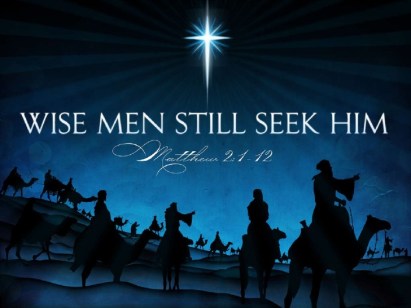
As I learned the solo and begin to think about the appearance of the Wise Men for Epiphany on January 6, I was struck once again by the faith and commitment on the part of the Wise Men to seek this unknown, newborn king.  I was reminded that the things we most often seem to seek, prosperity, possessions, peace, and many others, seem to pale in comparison to what the Wise Men sought.

My wife has a sweatshirt that she often wears this time of year, that has a star, wise men on camels, and, emblazoned in big letters, the words “Wise Men Still Seek Him.”  So I ask myself, and you, what are we seeking in this new year?  Is it the King of Kings?
FUMC Winnfield Leads Flood Relief Team

FUMC Winnfield Leads Flood Relief Team

winnfield-floodteam

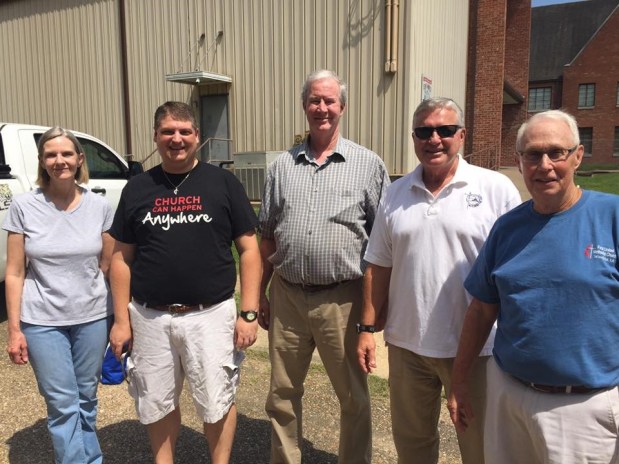
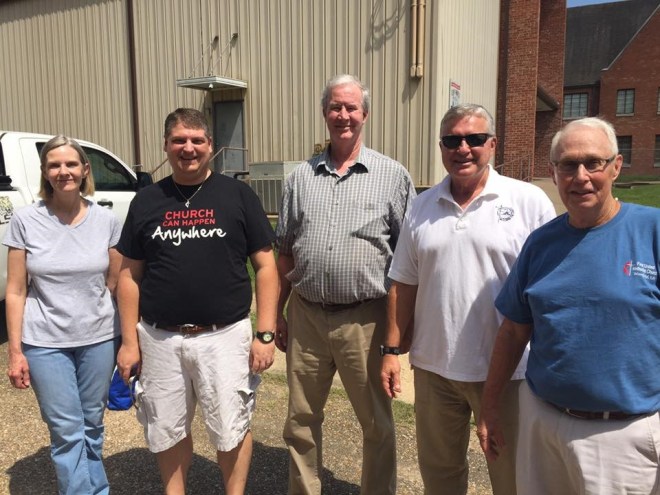
Left to right: Elise Shell, Kevin D. Smith, Kevin Koeppen, Glenn Ford and Tommy Harrel

On Sunday, September 4, Elise Shell, Kevin D. Smith, Kevin Koeppen, Glenn Ford and Tommy Harrel left First United Methodist Church Winnfield for a 4 day mission trip to help residents in flood ravaged Baton Rouge.  They stayed at First United Methodist Church of Baton Rouge (Downtown) and worked at Katie Young’s home on Clayton Drive in North Baton Rouge.  Katie is an 80 year old single lady whose home had never flooded before and had no flood insurance.  Even though Katie’s home was on piers and about two feet off the ground, she still received about 30 to 36 inches of water throughout most of her home.  Other homes in that neighborhood that were on a slab received over 5 feet of water in their home!

The team started their work on Monday, September 5.  After completing the necessary paperwork, meeting the family, and prayer, we started by removing the furniture, carpet, carpet pad, and lower kitchen cabinets.  All of these items had to be removed either by dolly or wheel barrow to the roadway where they will be picked up and thrown away by debris removal contractors.  It was emotional and heartbreaking to gather together, remove, and throw away clothes, pictures, pots, pans and so many other personal possessions.  Mucking out after a flood is literally taking all (or the vast majority) of your possessions that got wet, placing them near the street to be thrown away, and starting over from scratch.  It is difficult to imagine how hard this is unless you have been there.  You are throwing away treasured possessions and memories.  This took most of our first day.  It was a hot, emotional, difficult day, made only a little easier by Frostop floats and a good night’s rest at the end of the day.

The second day, we planned to gut the house, meaning removing wet materials

winnfield-flood-katie-young

Katie Young’s home in Baton Rouge received as much as 36 inches of water in a home that had never flooded befor

like sheetrock and insulation so that the studs, the framework of the house, can be exposed to the air and dry.  This is an essential step.  The studs must dry before being closed in so that mold and mildew do not form inside the walls.  We removed the paneling and the upper kitchen cabinets that were already moldy just three weeks after the flood.  As we began to remove the sheetrock below 4 feet from the floor, we discovered the sheetrock was nailed to a solid wall of tongue and groove boards throughout the house. The boards in Katie’s home were already molding and they were preventing us from exposing the studs so they could dry.  We consulted with several people and decided to remove two of the horizontal boards below the four foot line to allow air to the studs and begin the drying process.

Day three started with the process of removing the wooden tongue and groove boards.  This was difficult, tedious work, as the boards did not want to easily leave their home for so many years.  Many of them had to be cut out instead of pulled out with a crowbar or a wrecking bar.  This job took all day, especially since each board had to be wheeled out and piled near the street to be picked up and thrown away.  Our team was also down a man, since Pastor Kevin returned to Winnfield to lead Wednesday evening services.

After a good meal on Wednesday night (and another Root Beer Float), we were ready to finish on Thursday.  We removed the rest of the boards, exposing the studs, so that the drying process could finally begin.  The rebuilding process is still several weeks away as the interior studs must dry before rebuilding.  Before leaving, we gathered together to pray for God’s blessing on the house and its occupants.  We finished our work on Thursday afternoon and returned to Winnfield about 5 PM.

Special thanks to our friends at First United Methodist Baton Rouge for housing and feeding us.  They turned a portion of their Youth and Children’s building into a bunkhouse and provided us three meals a day.  Special thanks to these people who gave of their time, sweat, money, and themselves to help other people that they don’t even know.  Thanks to Rusty Russell for the use of his trailer and we are especially grateful to Ryan Etherige who loaned us a generator to run a few fans in a house without electricity.  Thank you to the people of First United Methodist Church Winnfield for providing us with tools and supplies to do the work.  Thank you to the community and our local businesses.  When we purchased tools and supplies, we shared with the businesses how we would be using them to help those who had been flooded.  Walmart and Tractor Supply gave us discounts.  We appreciate your support!

But don’t stop!  Don’t quit!  There remains much to be done!  The list of homes yet to be gutted is in the thousands!  While we working, some folks in the neighborhood asked if we could come help them next!  All we could do was refer them to our friends who were coordinating the effort.  Maybe you will be the ones who will help them!  The recovery of Baton Rouge will take years, perhaps decades.  Please continue to give, help, and pray for the people of Baton Rouge and surrounding areas.