Encouragement Matters

(Author’s Note: This article was originally written for the July 2025 Newsletter of Palestine Methodist Church where the author serves as pastor.)
.189 batting average for the year. 1 hit in his last 35 at bats (.029 batting average.) That’s how LSU 3rd baseman Michael Braswell III entered the College World Series. Ice cold. Driving the struggle bus. However you want to say it, it was not good.

But instead of criticizing or booing him, LSU fans started a movement on social media to give Braswell a standing ovation when he walked up to the plate for his first at bat in the College World Series. He didn’t get a hit that game, but he made some great plays in the field that contributed to LSU’s two game sweep and eighth National Championship in college baseball. LSU fans continued to cheer for Braswell, and he finally got a hit in the eighth inning of the game in which LSU won the title.

When asked after the game what it meant for the LSU fans “to wrap their arms around him like that”, Braswell replied “It meant the world to me. Those are the moments you dream of. You don’t dream of hitting .180, but you dream of a whole fan base being behind you and supporting you and I couldn’t ask for a better fan base ever.” (Watch Braswell’s entire interview at https://www.youtube.com/shorts/b02iMJN0mnM.)

Encouragement makes a difference. What if we decided to be an encourager instead of a discourager? Upbeat instead of Debbie Downer? As you might guess, the Bible has quite a bit to say about encouragement. 1 Thessalonians 5:11 says “Therefore encourage one another and build each other up, just as in fact you are doing.” Ephesians 4:29 may be even stronger: “Do not let any unwholesome talk come out of your mouths, but only what is helpful for building others up according to their needs, that it may benefit those who listen.” These are only two of the hundreds of verses that encourage us to cling to our faith and to encourage others. The Bible is clear, God intends for us to be encouragers.

A daily devotion I read is titled “The Wake Up Call” published by Seedbed and written by John David Walt, a pastor in the Trinity Conference serving Gillett Methodist Church in Gillett, Arkansas. The theme for this summer’s Wake Up Call is the “Summer of Encouragement” with each devotion designed to encourage and uplift the reader or listener. By the way, you can receive the Wake Up Call for free every day in your email box by subscribing at https://seedbed.com/wakeupcall/. You can listen at the same address or at apple podcasts, spotify, or iheartradio. Just reading or listening to it has encouraged me.

Who do you know that could use a bit of encouragement? How might you do that? Maybe you don’t have to give them a standing ovation, but you can encourage them. Maybe a word, maybe a letter or a text, maybe just a hug. Be an encourager. Because encouragement matters. Just ask Michael Braswell III.

Striving to be an Encourager,
Kevin D. Smith
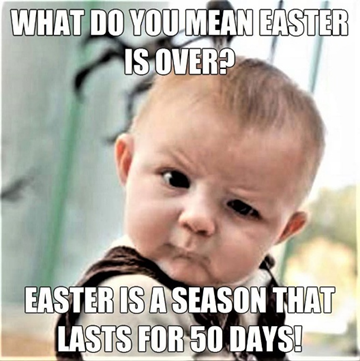
Easter is NOT Over!

(Author’s note- This article was written for the May edition of the Palestine Methodist Church newsletter. Find out more about Palestine Methodist Church at http://www.palestinemethodist.org)

Easter Sunday has come and gone. The Easter baskets (except for the Easter grass- that stuff gets EVERYWHERE) have been put away. The chocolate Easter bunnies have been eaten and whatever Easter candy is left in the stores is likely at least 50% off. The Easter bonnets and fancy Easter dresses and clothes have been shoved to the back of the closet until next year. The Easter Lilies have disappeared from the store shelves. All around us the world says that Easter is over.

But the church clearly says the Easter is not over. Easter in the church is a 50-day season that runs from Easter day to Pentecost. It is the most joyous and celebrative season of the Christian year. The white paraments of Easter day remain on the altar, pulpit, and lectern. We continue to sing the hymns that remind us that Jesus is alive and risen. Easter is the time when we celebrate Jesus’ resurrection, ascension, and the giving of the Holy Spirit. Easter is and should be a reminder to us that we believe daily in a risen and living Lord and Savior, Jesus Christ.

In fact, every Sunday is a “little Easter” when we remember that Jesus is alive. Even during Lent, Sundays are not counted in the 40 day season, because Sundays are feast days, days of celebration, days when we celebrate that Jesus is alive. Thus when you count the days of Lent on the calendar, the number of days is greater than 40, since Sundays are not counted.

What if we remembered every day that Jesus is alive? What if we celebrated his presence with us daily? In Romans 6:9-11, Paul writes “9 For we know that since Christ was raised from the dead, he cannot die again; death no longer has mastery over him. 10 The death he died, he died to sin once for all; but the life he lives, he lives to God. 11 In the same way, count yourselves dead to sin but alive to God in Christ Jesus.” (NIV, emphasis mine) What if we truly lived alive to God in Jesus? How might it change us? How might it change the world?


The next time you see the Easter bunnies and Easter lilies and all the other decorations and reminders of Easter on clearance because Easter Sunday has passed, remember that Easter is not over! We serve a risen and living savior and through his life, death, and resurrection he lives in us! Easter is not over, nor will it ever be, for those who are followers of Jesus. Praise be to God for a living Lord and Savior!

In the name of the LIVING Savior,
Kevin D. Smith

Friendly or Hospitable?

Author’s Note: This article was originally written for the April 2025 Newsletter for Palestine Methodist Church, Ball, LA. To view or receive an electronic copy of our newsletter, please follow us on Facebook at https://www.facebook.com/palgmc or send us an email to palgmc@gmail.com. You can receive a mailed copy of the newsletter by contacting us at (318) 640-9024 or contacting us at palgmc@gmail.com. Thank you for reading!

Before I even came to Palestine, I was told about how friendly this church is. I have already discovered for myself that you are one of the friendliest churches I have served. Being friendly is great, it is wonderful, it is necessary. But are we hospitable?

What is the difference between being friendly and being hospitable? Boy, I am glad you asked! Being friendly is building relationships with people we already know and love, i.e. friends and family. Hospitality is being welcoming to and building relationships with people we don’t know, i.e. strangers. Many churches are friendly, fewer are truly hospitable.

Why should we be hospitable and intentionally build relationships with people we don’t know? We are all children of God. What if we treated every person we met as a precious, valued, child of God? How might it change us? How might it change the world?

When we are hospitable, we never know with whom we might be interacting . The final chapter of the book of Hebrews is subtitled “Concluding Exhortations” in my Bible. It contains several short pieces of advice to the reader including this one in Hebrews 13:2 “Do not forget to show hospitality to strangers, for by so doing some people have shown hospitality to angels without knowing it.” When we show hospitality to strangers, we never know with whom we are interacting. What if we treated every stranger we met as an angel? How might it change us? How might it change the world?

How can we become a more hospitable (not just friendly) church? Again, I’m glad you asked and here’s a few ideas: (1) Practice the rule of ten. The rule of ten is that you greet everyone within ten feet of you, whether you have never met them or have known then for many years. Using the rule of ten almost assures that everyone is greeted at least once. (2) Practice the rule of three. Statistics say that guests are usually the first to leave, usually within the first three minutes. The rule of three states that you spend the first three minutes after service intentionally looking for guests before speaking to people you already know. (3) Be a first friend. A first friend intentionally watches for new guests, people attending for the first time, greets them, builds a relationship with them, maybe sits with them, introduces them to other people and invites them back to church.

Being friendly is a great start. It is not an ending point. Our call as followers of Jesus is to be hospitable and welcoming not only to people we know, but to strangers and people we don’t know. My prayer is that Palestine would not only be the friendliest church in the area, but also the most hospitable to any child of God who attends our services or walks in our doors.

In Christ’s Love,
Kevin D. Smith

Inward Qualities are More Important than Outward Qualities

(Author’s Note: I have been preaching a message series from 1 Samuel during the summer of 2024 at Grace Methodist Church of Ruston. This article is an excerpt from the June 23, 2024 message)

1 Samuel 16:7 makes the telling point that inward qualities are more important than outward ones. “The Lord said to Samuel, “Do not look on his appearance or on the height of his stature, because I have rejected him; for the Lord sees not as a man sees; man looks on the outward appearance, but the Lord looks on the heart.”

There’s an old saying: “You never get a second chance to make a good first impression.” And that’s too bad, because first impressions generally do not reveal inward qualities. The anointing of David demonstrates to us that we are to look deeper into each other than to see only what’s on the surface.
As Jesse presented his sons to the prophet, Samuel thought ““Surely the Lord’s anointed stands here before the Lord.” (16:6) “But the Lord said to Samuel, “Do not consider his appearance or his height, for I have rejected him. The Lord does not look at the things people look at. People look at the outward appearance, but the Lord looks at the heart.” (16:7)

I can only imagine Samuel’s confusion as the last son was presented and God said “no, not him”. He turned to Jesse and said, “Is this all?” There was one more son; he was out in the fields taking care of the sheep. Notice that Jesse hadn’t even thought to bring him in. He certainly wasn’t king material. His dad and brothers knew that. But Samuel was insistent and so he was brought into the house and suddenly this young nobody became somebody.

It’s hard for us to understand exactly why David would have been such an unlikely candidate for king, but let me give you three reasons to help paint the picture. First of all, David had an undistinguished family tree. His grandmother was an immigrant and among his ancestors was a woman almost executed for adultery and a prostitute. What kind of kingly lineage was that? His bloodline just wasn’t right. The second thing that made him such an unlikely candidate was that he was in the wrong place in the birth order. He was the youngest son. How many are youngest children? You know what it’s like to live in the shadow of your older siblings.

In David’s day and age your birth order determined your lot in life. The youngest child had a very unlikely prospect for success. The oldest son when he was of age would begin working with his father on the farm as soon as he was old enough to help or tend the sheep. But, when the next oldest son became old enough to help, the older son might leave home to start his own farm, learn a trade, or get married. He could decide to stay on the farm or not. This succession would continue until the last son would ultimately become the family’s shepherd and farm hand because there was no one to come behind him to replace him. David’s place in life was already determined. He had a job and apparently was good at that job from what we’re told later on in his life.

The fact is if we had been living in the farmhouse next door to David’s family on the Judean hillside, we may not have even known the name of David’s youngest son. His dad didn’t even think of including him until Samuel asked him if there were any more. Jesse rubbed his beard and said, “Oh, yeah, there’s my youngest. Almost forgot about him.” So fathers, don’t forget to present all your sons when the prophet comes to visit.

Samuel was so in tune with God that he listened to His will in selecting David to be anointed as king. And, arguably, David was Israel’s greatest king. The story of David is a story of right seeing. It’s a story which challenges us to look beyond outward appearances to a person’s heart and character. God saw something in David that no one else had seen. The Hebrew word that is used in the text to describe how Samuel looked at Jesse’s sons implies that he looked but didn’t really see. Inward qualities are more important than outward.