Encouragement Matters

(Author’s Note: This article was originally written for the July 2025 Newsletter of Palestine Methodist Church where the author serves as pastor.)
.189 batting average for the year. 1 hit in his last 35 at bats (.029 batting average.) That’s how LSU 3rd baseman Michael Braswell III entered the College World Series. Ice cold. Driving the struggle bus. However you want to say it, it was not good.

But instead of criticizing or booing him, LSU fans started a movement on social media to give Braswell a standing ovation when he walked up to the plate for his first at bat in the College World Series. He didn’t get a hit that game, but he made some great plays in the field that contributed to LSU’s two game sweep and eighth National Championship in college baseball. LSU fans continued to cheer for Braswell, and he finally got a hit in the eighth inning of the game in which LSU won the title.

When asked after the game what it meant for the LSU fans “to wrap their arms around him like that”, Braswell replied “It meant the world to me. Those are the moments you dream of. You don’t dream of hitting .180, but you dream of a whole fan base being behind you and supporting you and I couldn’t ask for a better fan base ever.” (Watch Braswell’s entire interview at https://www.youtube.com/shorts/b02iMJN0mnM.)

Encouragement makes a difference. What if we decided to be an encourager instead of a discourager? Upbeat instead of Debbie Downer? As you might guess, the Bible has quite a bit to say about encouragement. 1 Thessalonians 5:11 says “Therefore encourage one another and build each other up, just as in fact you are doing.” Ephesians 4:29 may be even stronger: “Do not let any unwholesome talk come out of your mouths, but only what is helpful for building others up according to their needs, that it may benefit those who listen.” These are only two of the hundreds of verses that encourage us to cling to our faith and to encourage others. The Bible is clear, God intends for us to be encouragers.

A daily devotion I read is titled “The Wake Up Call” published by Seedbed and written by John David Walt, a pastor in the Trinity Conference serving Gillett Methodist Church in Gillett, Arkansas. The theme for this summer’s Wake Up Call is the “Summer of Encouragement” with each devotion designed to encourage and uplift the reader or listener. By the way, you can receive the Wake Up Call for free every day in your email box by subscribing at https://seedbed.com/wakeupcall/. You can listen at the same address or at apple podcasts, spotify, or iheartradio. Just reading or listening to it has encouraged me.

Who do you know that could use a bit of encouragement? How might you do that? Maybe you don’t have to give them a standing ovation, but you can encourage them. Maybe a word, maybe a letter or a text, maybe just a hug. Be an encourager. Because encouragement matters. Just ask Michael Braswell III.

Striving to be an Encourager,
Kevin D. Smith

Preparation Matters

Blackberry Candy. One of the author’s favorite daylilies.

(Author’s note: This article was originally written for the June Newsletter of the Palestine Methodist Church in Ball, LA where the author serves as pastor.)
I admit it. I have a flower fixation. I suppose as fixations go, flowers are one of the best. I come by it honestly. My grandfather had a large vegetable garden and grew beautiful roses. My mom and dad grew roses and many other flowers and plants. Since moving, I have planted caladiums and impatiens, hung ferns on the front porch, and built beds for my favorite flower, daylilies.

But it was a lot of time and work. First, I killed the grass and weeds. Then, I cleared the space of competing plants. Tilled the soil. Next, I raked out the grass, weeds, roots, and other impediments to growth. Added improvements (cow manure) to the soil. Placed edging to protect the plants and keep weeds and grass out. Finally, the soil is ready to plant. Now, all I need is time, water, sunshine, and a bit of fertilizer.

Preparation matters. Without proper preparation, the plants stand little chance to grow. With proper preparation, I hope they will thrive. In the secular world, the saying goes “to fail to plan is to plan to fail.” If you were a scout, you know the Scout motto “Be Prepared.” As I was working on my flower beds, I thought, what would happen if I put this much preparation into my spiritual life? Do I put as much preparation into my spiritual life as I put into flowers and plants? As much preparation as I put into my job and career? As much preparation as I put into my fishing trip or hunting trip or other types of recreation?

How can we be spiritually prepared? Do we spend time in God’s Word regularly, perhaps with the help of a devotional book such as the Upper Room, Our Daily Bread, or a number of online devotionals? Do we pray regularly? Do we attend worship on Sunday? Are we a part of a small group such as a Sunday School class? All of these things and more can help us be spiritually prepared for God to grow and move in our lives.

As David prepared to face Goliath the giant, he told King Saul “Your servant has killed both the lion and the bear; this uncircumcised Philistine will be like one of them, because he has defied the armies of the living God.” 1 Samuel 17:36. Did you hear that? David was prepared to face the giant because God had already helped him defeat the lion and the bear. What challenges have you overcome? What lion and bear have you defeated? Perhaps God is preparing you to face a giant.

Preparation matters in the garden, in life, and in our spiritual lives. If we aren’t doing the preparation, then we cannot expect the fruit or the flowers. But when we prepare, we open the door for God to bless us and to help us defeat whatever giants we face.


Preparing for Growth,
Kevin D. Smith

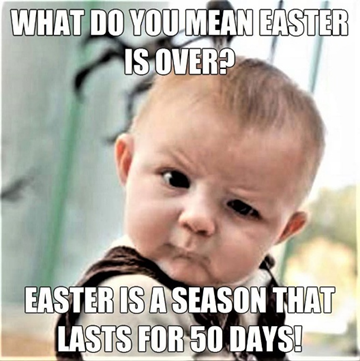
Easter is NOT Over!

(Author’s note- This article was written for the May edition of the Palestine Methodist Church newsletter. Find out more about Palestine Methodist Church at http://www.palestinemethodist.org)

Easter Sunday has come and gone. The Easter baskets (except for the Easter grass- that stuff gets EVERYWHERE) have been put away. The chocolate Easter bunnies have been eaten and whatever Easter candy is left in the stores is likely at least 50% off. The Easter bonnets and fancy Easter dresses and clothes have been shoved to the back of the closet until next year. The Easter Lilies have disappeared from the store shelves. All around us the world says that Easter is over.

But the church clearly says the Easter is not over. Easter in the church is a 50-day season that runs from Easter day to Pentecost. It is the most joyous and celebrative season of the Christian year. The white paraments of Easter day remain on the altar, pulpit, and lectern. We continue to sing the hymns that remind us that Jesus is alive and risen. Easter is the time when we celebrate Jesus’ resurrection, ascension, and the giving of the Holy Spirit. Easter is and should be a reminder to us that we believe daily in a risen and living Lord and Savior, Jesus Christ.

In fact, every Sunday is a “little Easter” when we remember that Jesus is alive. Even during Lent, Sundays are not counted in the 40 day season, because Sundays are feast days, days of celebration, days when we celebrate that Jesus is alive. Thus when you count the days of Lent on the calendar, the number of days is greater than 40, since Sundays are not counted.

What if we remembered every day that Jesus is alive? What if we celebrated his presence with us daily? In Romans 6:9-11, Paul writes “9 For we know that since Christ was raised from the dead, he cannot die again; death no longer has mastery over him. 10 The death he died, he died to sin once for all; but the life he lives, he lives to God. 11 In the same way, count yourselves dead to sin but alive to God in Christ Jesus.” (NIV, emphasis mine) What if we truly lived alive to God in Jesus? How might it change us? How might it change the world?


The next time you see the Easter bunnies and Easter lilies and all the other decorations and reminders of Easter on clearance because Easter Sunday has passed, remember that Easter is not over! We serve a risen and living savior and through his life, death, and resurrection he lives in us! Easter is not over, nor will it ever be, for those who are followers of Jesus. Praise be to God for a living Lord and Savior!

In the name of the LIVING Savior,
Kevin D. Smith

Inward Qualities are More Important than Outward Qualities

(Author’s Note: I have been preaching a message series from 1 Samuel during the summer of 2024 at Grace Methodist Church of Ruston. This article is an excerpt from the June 23, 2024 message)

1 Samuel 16:7 makes the telling point that inward qualities are more important than outward ones. “The Lord said to Samuel, “Do not look on his appearance or on the height of his stature, because I have rejected him; for the Lord sees not as a man sees; man looks on the outward appearance, but the Lord looks on the heart.”

There’s an old saying: “You never get a second chance to make a good first impression.” And that’s too bad, because first impressions generally do not reveal inward qualities. The anointing of David demonstrates to us that we are to look deeper into each other than to see only what’s on the surface.
As Jesse presented his sons to the prophet, Samuel thought ““Surely the Lord’s anointed stands here before the Lord.” (16:6) “But the Lord said to Samuel, “Do not consider his appearance or his height, for I have rejected him. The Lord does not look at the things people look at. People look at the outward appearance, but the Lord looks at the heart.” (16:7)

I can only imagine Samuel’s confusion as the last son was presented and God said “no, not him”. He turned to Jesse and said, “Is this all?” There was one more son; he was out in the fields taking care of the sheep. Notice that Jesse hadn’t even thought to bring him in. He certainly wasn’t king material. His dad and brothers knew that. But Samuel was insistent and so he was brought into the house and suddenly this young nobody became somebody.

It’s hard for us to understand exactly why David would have been such an unlikely candidate for king, but let me give you three reasons to help paint the picture. First of all, David had an undistinguished family tree. His grandmother was an immigrant and among his ancestors was a woman almost executed for adultery and a prostitute. What kind of kingly lineage was that? His bloodline just wasn’t right. The second thing that made him such an unlikely candidate was that he was in the wrong place in the birth order. He was the youngest son. How many are youngest children? You know what it’s like to live in the shadow of your older siblings.

In David’s day and age your birth order determined your lot in life. The youngest child had a very unlikely prospect for success. The oldest son when he was of age would begin working with his father on the farm as soon as he was old enough to help or tend the sheep. But, when the next oldest son became old enough to help, the older son might leave home to start his own farm, learn a trade, or get married. He could decide to stay on the farm or not. This succession would continue until the last son would ultimately become the family’s shepherd and farm hand because there was no one to come behind him to replace him. David’s place in life was already determined. He had a job and apparently was good at that job from what we’re told later on in his life.

The fact is if we had been living in the farmhouse next door to David’s family on the Judean hillside, we may not have even known the name of David’s youngest son. His dad didn’t even think of including him until Samuel asked him if there were any more. Jesse rubbed his beard and said, “Oh, yeah, there’s my youngest. Almost forgot about him.” So fathers, don’t forget to present all your sons when the prophet comes to visit.

Samuel was so in tune with God that he listened to His will in selecting David to be anointed as king. And, arguably, David was Israel’s greatest king. The story of David is a story of right seeing. It’s a story which challenges us to look beyond outward appearances to a person’s heart and character. God saw something in David that no one else had seen. The Hebrew word that is used in the text to describe how Samuel looked at Jesse’s sons implies that he looked but didn’t really see. Inward qualities are more important than outward.

Sacrifice for the Good of All

Sacrifice for the Good of All

(Author’s note: This article was originally published in the March 2018 FUMC Winnfield Newsletter “The Cross and Tower.”  The entire newsletter can be accessed at www.fumcwinnfield.com)

lsu baseball logo

It’s that time of year again! The crack of the bat! The ball hitting leather! Stand for the national anthem, then the umpire says “play ball” and the baseball or softball game begins. At the writing of this article, I have just watched Winnfield Senior High’s first baseball game of the year, opening weekend for the LSU Tigers, and am anxiously awaiting to see if my favorite Major League team, the Houston Astros, can become the first World Series repeat champions since 2000. Yes, it is time for the rite of spring, America’s game, baseball and softball.

This game that is often called “America’s pastime” contains something unique. It is an idea that carries over into the life of the church and especially applies to us during Lent, that spring season when we prepare our hearts and lives for the death and resurrection of Jesus. The idea that bridges faith with baseball and softball is sacrifice.

In baseball and softball, a sacrifice occurs when a batter voluntarily makes an out for the good of his or her team. Often, this is done to move a runner to the next base or even to score a run for the team through a sacrifice bunt or a sacrifice fly ball.


sacrifice cross

In faith, a sacrifice is an animal or person who gives his life for the good of all. In the Old Testament, this was done through the shedding of blood of animals. In the New Testament, one man, Jesus Christ, gave his life so that we might have life. 1 John 2:2 says “He (Jesus) is the atoning sacrifice for our sins, and not only for ours but also for the sins of the whole world.” (NIV)

I am thankful for baseball and softball. Not only because I enjoy watching it, enjoy watching the children and youth of our church play, enjoy being outside,  but because it keeps this word “sacrifice” in our vocabulary. Think about it. When is the last time you used the word “sacrifice” outside of a baseball/softball or faith context? When is the last time you thought about what it means to make a sacrifice and what it costs? The haunting question that comes back to us is what have we sacrificed for the good of others, for our team, for our faith. The truth is that we don’t really like to sacrifice our wants, our desires, our at bat, for the good of others. But that is exactly what the batter is asked to do. That is exactly what Jesus did.


The next time you watch a baseball or softball game and a player makes a sacrifice for the good of the team, I hope you’ll think of Jesus, who sacrificed himself for the good of all

Questions to ponder:  Are you a baseball/softball fan?  Why or why not? When is the last time you mentioned sacrifice outside of a baseball/softball or faith context?  What have we sacrificed for the good of our team or our faith?

Take Time to Fish Between the Cracks

toledo bend 3

Sunset from Sunset Marina on Toledo Bend near Many, Louisiana.

Bloggers Note:  Every week there are stories and information that I want to tell in my message but there is simply not enough time.  My message this past Sunday “Going Fishing” from Mark 1:14-20 was like that. This story by Terry Higginbotham was left on the cutting room floor.  But it is worth the read.  Please note: this is not my work.  The original author is Terry Higginbotham copyright 2004.


The summer of 1972, my brother and I were filling cricket and bait buckets for Mr. K.C. Bray at the Sunset Marina on the Toledo Bend Reservoir just south of Many, Louisiana.

It was just another hot, humid, July in the southwest Louisiana. Each day the same as yesterday and with almost certainty the same as it would be tomorrow. The wind was so still that the Spanish moss barely rustled in the old cypress trees. But these were the type of days I liked, cause the fishing would be good. Good fishing meant good tips.

Lil’ Brother and I never did make a lot of money, but enough to keep us just short of even on our account at Mr. K.C.`s store. Our daily provisions consisted of two cokes, a moon pie, a Miss. Dailey’s fresh made sandwich, and all the crickets we needed to catch our supper. By 7:00 p.m., every evening we would have our 3 bream apiece. We would gut `em, stick `em, and cook `em over a little fire we would make on the bank near our tent.

Lil’ Brother and I had spent the last two summers camping on the banks of the Bend. We fancied ourselves as a modern day Tom Sawyer and Huck Finn. We were accountable to no one and responsible for only our daily bread. Don’t get me wrong, we were not bad kids nor did we come from a broken home. We had loving parents, grandparents, and friends. We were just lucky enough to grow up in a part of the world and in a time that allowed us to live free, truly free.

Our parents would come to the Bend on the weekends and we would get a reprieve from our day-to-day attempts to “survive”. We didn’t know until years later that mom and dad gave Mr. K.C. money to cover our supper in the case fishing ever went bad. They would bring us fresh clothes, comic books, candy, and fresh tackle for our nightly fishing. They would stay for the weekend then head for real world late on Sunday Evening.

On Friday night we would all go down to the dock. We would sit for hours talking about the week’s events. Lil Brother and I would tell about our adventures. Dad would tell us stories about the jobs he was on. Dad was an ironworker and we were fascinated by his stories of “walking in the air”. To us he was a superhero. Saturday we would spend the day fishing, swimming, and skiing.

Sunday morning was spent at “church”. We would go down to the dock, bait a couple of hand lines. We would then lower the hand lines through the cracks in the dock. The really big fish would rest in the shade, just under the dock. The best way to get to them was to fish through the cracks where the two floating partitions of the dock joined. While Lil’ Brother and I would fish for the Big Ones, Daddy would read to us about becoming “Fishers of Men”. Some of the best times of my life were spent belly down on that old dock, coaxing those big bluegills out with worms and crickets. As I look back on it now, it wasn’t because of the fishing but because of the time spent with Dad and Lil’ Brother.

Recently my dad came to visit. I was in the midst of a major project and wasn’t spending much time with him. Maybe a few minutes in the morning and an hour or so at night, before I passed out from exhaustion. On his last night, I finally got to tell him about the new boat I just bought. About the rods and reels, tackle, and accessories just waiting until we got a chance to go fishing. I told him about the cabin on Toledo Bend that we were going to rent, as soon as I got enough time to go. I told him about how excited the kids were when I had brought home new rods and reels for them, last month. He seemed to enjoy the talk although he seemed very quiet and almost sad.

My dad left that next morning. As we shook hands, he drew me near and presented me with an old box. He whispered, “The secrets to a happy life are in here”. Dad was always a little strange when it came to good-byes, so I just smiled, waved and watched him slowly drive out of sight.

The small box was worn red with a small picture of a man battling a giant bass. Below the picture was the caption “Sunset Marina Toledo Bend Many, Louisiana”. I slowly opened the box and smiled as I became aware of its contents. Truly these were the “secrets of life”. In the box was a small bible with a bookmark with Matthew 4:19 printed on it. It had been a while but I did remember, “Follow Me and I will make you Fishers of Men”. Beside the Bible was a small hand line wrapped in a piece of paper with my dad’s handwriting scrawled on it. I unfolded the note and smiled as I read the simple key to a happy life.

“Son, Make time to fish through the cracks”.

Today isn’t just another hot, humid, July day in southwest Louisiana. Not quite the same as yesterday and with almost certainty the same as it will be tomorrow.

“Hey Jon, throw dad another moon pie”.

“Just a minute dad, I think Erin’s got another one”.

“Be careful not to lose him, it’s a little tricky getting ’em back through the cracks”.

“Hey dad”.

“Yeah, Jon”.

“Was fishing this good when you were a kid?”

“Almost”.

(c) Copyright 2004 OuachitaGroup All Rights Reserved

Owner of HuntStats.com and The OuachitaGroup, Terry Higginbotham, is an avid hunter, fisherman, and outdoorsman. He runs a research project studying the Whitetail Deer and the American Wild Turkey. Information from this study is available online at HuntStats.com or by email at: articles@HuntStats.com

New Every Morning

daylily collage

A few pictures of the author’s daylilies from the yard.

Gardening has been a part of my family’s life for as long as I can remember. Some of my best memories took place in a garden, picking carrots, blueberries, blackberries, pears, and many other fruits and vegetables. We also spent many hours fertilizing, spraying, and caring for flowers like roses, calla lilies, and many other varieties.

Gardening not only connects me to my family, but also to my faith. The creation story in Genesis takes place in a garden (Genesis 2-3). The night before he was crucified, Jesus prayed in an olive garden, the garden of Gethsemane (Matthew 26:36-46). Following his crucifixion, Jesus is placed in a tomb in a garden (John 19:38-42). After his resurrection, Mary Magdalene mistakes Jesus for a gardener (John 20:11-18). In Jerusalem, I visited the Garden Tomb, which could be the place where Jesus was placed, and where people from all over the world gather to worship. In death, many caskets and funerals, are graced with stands, sprays, and wreaths of flowers or live plants as a symbol of life even in the midst of death.

I have several plants in my garden. Roses, bearded irises, Louisiana irises, lantana, gladiolus, and annuals such as zinnias and salvinia to attract butterflies and hummingbirds. But my favorite is the daylily. I like dayliles for several reasons. First, they are tough. My daylilies have survived several moves, transplants, and other challenges that would kill many flowers. Often, they have bloomed in the boxes or bags in which I moved them! They grow almost anywhere, in almost any soil, though they do best with lots of sun. Second, there are many varieties and variations. If you don’t believe God likes variety, look at the daylily! Daylilies can be found in almost all shades of the rainbow (except blue). Some are small (as small as 2 inches), others are large (as big as 10 inches), while most fall somewhere in between. Daylilies have many forms.  Some have eyes or colored edges, others have rounded forms or long, spindly arms (usually called spiders). Daylilies have many varieties and variations.

My favorite thing about daylilies is that they are new each day. The scientific name (hemorocallis) literally means “beauty for a day.” And that is what they do. Bloom for one day. Only. Then they die. When I walk through my garden, one cultivar that was a beautiful flower yesterday is now a dull, lifeless husk. Conversely, one bud that yesterday was only the promise of a bloom has blossomed into a beautiful flower. Here today, gone tomorrow. Just like life. Just like us. The daylily reminds me of what lasts, and what does not. “The grass withers and the flowers fall, but the word of our God endures forever” Isaiah 40:8. I am reminded, that like the lilies are new every morning, so is God’s mercy. “22 Because of the Lord’s great love we are not consumed, for his compassions never fail. 23 They are new every morning; great is your faithfulness.” Lamentations 3:22-23

The next time you see a beautiful daylily, beautiful for only a day, think about what lasts and what passes away. Maybe, like me, you will find a blessing that is new every morning.

What Do You Cling to in the Storm?

What Do You Cling to in the Storm?

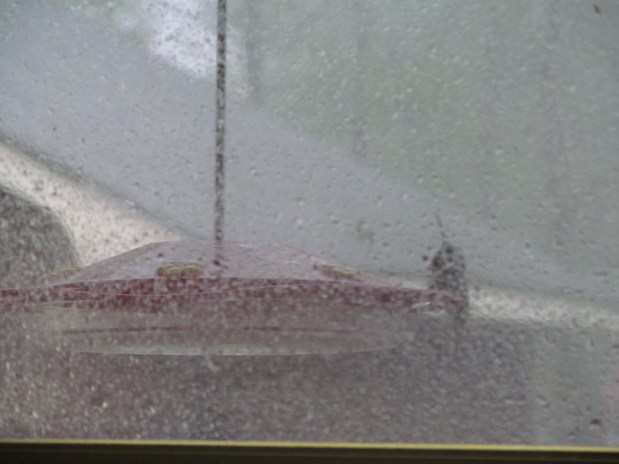
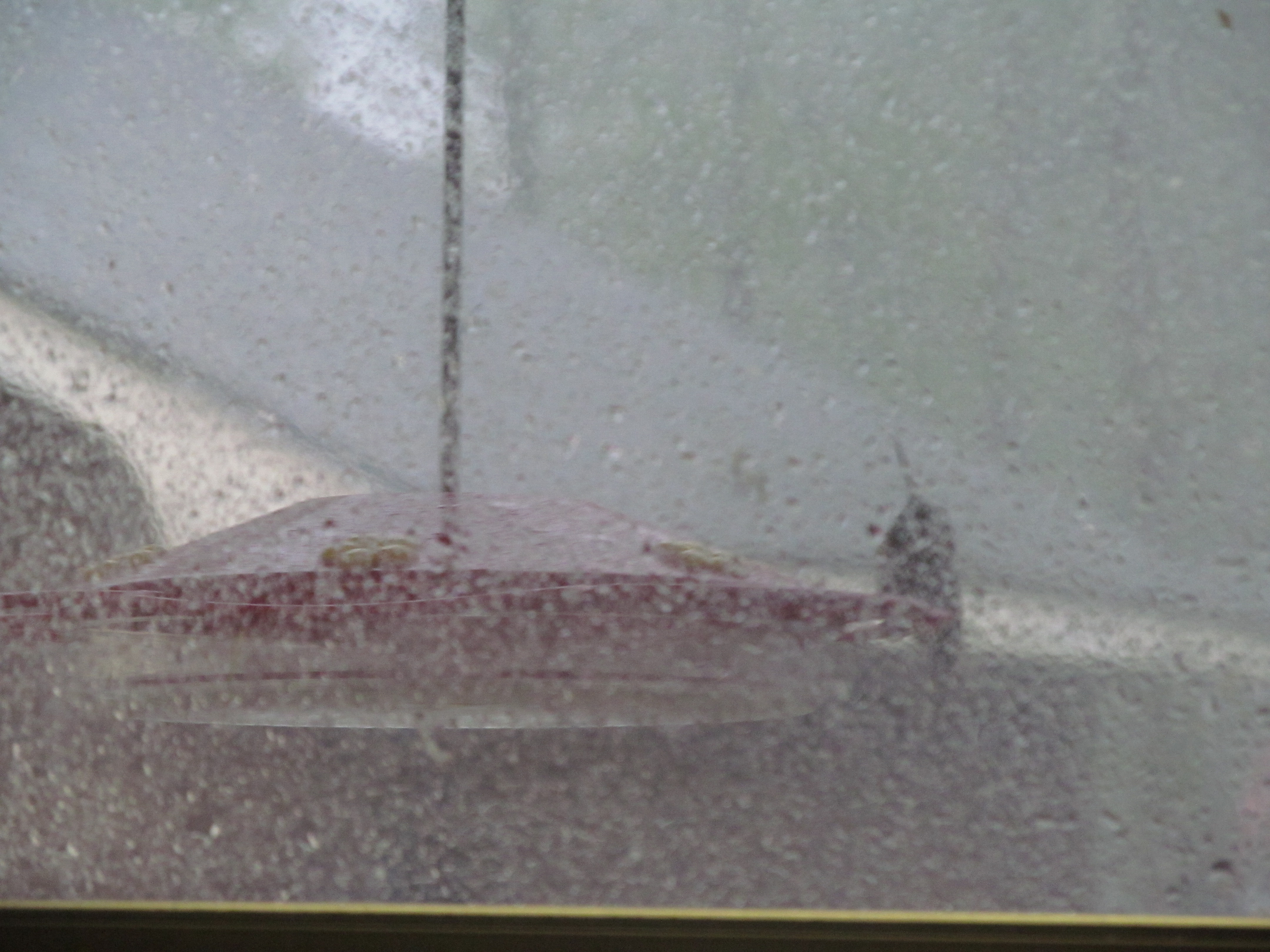
A Ruby Throated Hummingbird clings to a feeder outside our kitchen window on a stormy day.

A Ruby Throated Hummingbird clings to a feeder outside our kitchen window on a stormy day.

On Saturday, August 30, 2014 a storm rolled through our village with heavy rain and strong winds.  The airport in McComb, Mississippi recorded a gust of 34 mph and sustained winds of 17 mph (http://www.wunderground.com/history/airport/KMCB/2014/8/30/DailyHistory.html).  There are probably places where winds like this would be normal, but that is not the case here in my corner of Louisiana.  I had put the dogs out before the storm and was looking out of the kitchen window, where our hummingbird feeder was located, watching the storm roll in.  While looking out of our window, I was surprised to see that the storm had not slowed down our hummingbirds one bit!  All of the other birds, the chickadees, the titmice, the cardinals, the sparrows, were taking shelter and waiting out the storm to feed, but the smallest of all of the birds was still out in the tempest, fighting to get something to eat.  I was reminded of this picture I took several years ago while we were being assaulted by one of the tropical systems to make its way through South Louisiana (I think I took it during Tropical Storm Lee in September of 2011).  As I watched the hummingbirds in the storm, I couldn’t help but wonder what you and I cling to in the storm.

I wish I could tell you that storms would never come, but that is not true.  Growing up in South Louisiana, watching the tropics was a part of my everyday life.  In the 8 years we lived in Tangipahoa, we have gone through Hurricane Gustav, Tropical Storm Lee, and Tropical Storm Karen.  That is not to mention the 3 snowfalls and numerous thunderstorms.  Personally, we are suffering through a storm as my parents and thousands of others in the Baton Rouge area and all across South Louisiana have flooded due to historic rainfall.  Life has changed for many, maybe even permanently.

Of course, there are other kinds of storms in our lives.  Ones that do not involve water or wind or earthquakes.  The death of a loved one, a prolonged or sudden illness, age, loss of a job, or any multitude of other things can shake us to our core as quickly as a California earthquake.  What do we hold on to during these times?  What do we cling to in the storm?

I imagine that we, like this hummingbird, cling to that which is most important to us in the storm.  Family, friends, and faith may be some of the things that we cling to when the wind blows and the rain pours.  As important as friends and family are, they have their limits.  Like all humans, they are limited in time, strength and resources.  But there is one who is not limited by time, strength or resources- God.  So when the storm comes, as it does for all of us, I believe that we should not only turn to friends, family, and the church, but to God.

Psalm 46:1-3 reads “1God is our refuge and strength, a very present help in trouble. 2Therefore we will not fear, though the earth should change, though the mountains shake in the heart of the sea; 3though its waters roar and foam, though the mountains tremble with its tumult.” This scripture describe dark and difficult times, much like we are going through, much like all of us go through at one time or another.  But the Psalmist is clear that we will not fear and even ends with these words “10Be still, and know that I am God! I am exalted among the nations, I am exalted in the earth.11The Lord of hosts is with us; the God of Jacob is our refuge”.  When tough times come, when the storm comes, cling to faith in God, family and friends to get us through.