Encouragement Matters

(Author’s Note: This article was originally written for the July 2025 Newsletter of Palestine Methodist Church where the author serves as pastor.)
.189 batting average for the year. 1 hit in his last 35 at bats (.029 batting average.) That’s how LSU 3rd baseman Michael Braswell III entered the College World Series. Ice cold. Driving the struggle bus. However you want to say it, it was not good.

But instead of criticizing or booing him, LSU fans started a movement on social media to give Braswell a standing ovation when he walked up to the plate for his first at bat in the College World Series. He didn’t get a hit that game, but he made some great plays in the field that contributed to LSU’s two game sweep and eighth National Championship in college baseball. LSU fans continued to cheer for Braswell, and he finally got a hit in the eighth inning of the game in which LSU won the title.

When asked after the game what it meant for the LSU fans “to wrap their arms around him like that”, Braswell replied “It meant the world to me. Those are the moments you dream of. You don’t dream of hitting .180, but you dream of a whole fan base being behind you and supporting you and I couldn’t ask for a better fan base ever.” (Watch Braswell’s entire interview at https://www.youtube.com/shorts/b02iMJN0mnM.)

Encouragement makes a difference. What if we decided to be an encourager instead of a discourager? Upbeat instead of Debbie Downer? As you might guess, the Bible has quite a bit to say about encouragement. 1 Thessalonians 5:11 says “Therefore encourage one another and build each other up, just as in fact you are doing.” Ephesians 4:29 may be even stronger: “Do not let any unwholesome talk come out of your mouths, but only what is helpful for building others up according to their needs, that it may benefit those who listen.” These are only two of the hundreds of verses that encourage us to cling to our faith and to encourage others. The Bible is clear, God intends for us to be encouragers.

A daily devotion I read is titled “The Wake Up Call” published by Seedbed and written by John David Walt, a pastor in the Trinity Conference serving Gillett Methodist Church in Gillett, Arkansas. The theme for this summer’s Wake Up Call is the “Summer of Encouragement” with each devotion designed to encourage and uplift the reader or listener. By the way, you can receive the Wake Up Call for free every day in your email box by subscribing at https://seedbed.com/wakeupcall/. You can listen at the same address or at apple podcasts, spotify, or iheartradio. Just reading or listening to it has encouraged me.

Who do you know that could use a bit of encouragement? How might you do that? Maybe you don’t have to give them a standing ovation, but you can encourage them. Maybe a word, maybe a letter or a text, maybe just a hug. Be an encourager. Because encouragement matters. Just ask Michael Braswell III.

Striving to be an Encourager,
Kevin D. Smith

Preparation Matters

Blackberry Candy. One of the author’s favorite daylilies.

(Author’s note: This article was originally written for the June Newsletter of the Palestine Methodist Church in Ball, LA where the author serves as pastor.)
I admit it. I have a flower fixation. I suppose as fixations go, flowers are one of the best. I come by it honestly. My grandfather had a large vegetable garden and grew beautiful roses. My mom and dad grew roses and many other flowers and plants. Since moving, I have planted caladiums and impatiens, hung ferns on the front porch, and built beds for my favorite flower, daylilies.

But it was a lot of time and work. First, I killed the grass and weeds. Then, I cleared the space of competing plants. Tilled the soil. Next, I raked out the grass, weeds, roots, and other impediments to growth. Added improvements (cow manure) to the soil. Placed edging to protect the plants and keep weeds and grass out. Finally, the soil is ready to plant. Now, all I need is time, water, sunshine, and a bit of fertilizer.

Preparation matters. Without proper preparation, the plants stand little chance to grow. With proper preparation, I hope they will thrive. In the secular world, the saying goes “to fail to plan is to plan to fail.” If you were a scout, you know the Scout motto “Be Prepared.” As I was working on my flower beds, I thought, what would happen if I put this much preparation into my spiritual life? Do I put as much preparation into my spiritual life as I put into flowers and plants? As much preparation as I put into my job and career? As much preparation as I put into my fishing trip or hunting trip or other types of recreation?

How can we be spiritually prepared? Do we spend time in God’s Word regularly, perhaps with the help of a devotional book such as the Upper Room, Our Daily Bread, or a number of online devotionals? Do we pray regularly? Do we attend worship on Sunday? Are we a part of a small group such as a Sunday School class? All of these things and more can help us be spiritually prepared for God to grow and move in our lives.

As David prepared to face Goliath the giant, he told King Saul “Your servant has killed both the lion and the bear; this uncircumcised Philistine will be like one of them, because he has defied the armies of the living God.” 1 Samuel 17:36. Did you hear that? David was prepared to face the giant because God had already helped him defeat the lion and the bear. What challenges have you overcome? What lion and bear have you defeated? Perhaps God is preparing you to face a giant.

Preparation matters in the garden, in life, and in our spiritual lives. If we aren’t doing the preparation, then we cannot expect the fruit or the flowers. But when we prepare, we open the door for God to bless us and to help us defeat whatever giants we face.


Preparing for Growth,
Kevin D. Smith

Easter is NOT Over!

(Author’s note- This article was written for the May edition of the Palestine Methodist Church newsletter. Find out more about Palestine Methodist Church at http://www.palestinemethodist.org)

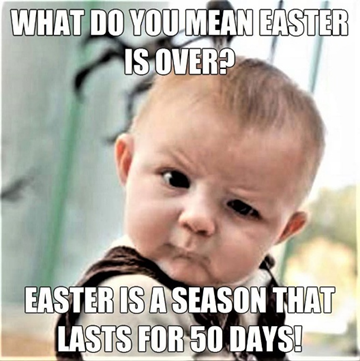
Easter Sunday has come and gone. The Easter baskets (except for the Easter grass- that stuff gets EVERYWHERE) have been put away. The chocolate Easter bunnies have been eaten and whatever Easter candy is left in the stores is likely at least 50% off. The Easter bonnets and fancy Easter dresses and clothes have been shoved to the back of the closet until next year. The Easter Lilies have disappeared from the store shelves. All around us the world says that Easter is over.

But the church clearly says the Easter is not over. Easter in the church is a 50-day season that runs from Easter day to Pentecost. It is the most joyous and celebrative season of the Christian year. The white paraments of Easter day remain on the altar, pulpit, and lectern. We continue to sing the hymns that remind us that Jesus is alive and risen. Easter is the time when we celebrate Jesus’ resurrection, ascension, and the giving of the Holy Spirit. Easter is and should be a reminder to us that we believe daily in a risen and living Lord and Savior, Jesus Christ.

In fact, every Sunday is a “little Easter” when we remember that Jesus is alive. Even during Lent, Sundays are not counted in the 40 day season, because Sundays are feast days, days of celebration, days when we celebrate that Jesus is alive. Thus when you count the days of Lent on the calendar, the number of days is greater than 40, since Sundays are not counted.

What if we remembered every day that Jesus is alive? What if we celebrated his presence with us daily? In Romans 6:9-11, Paul writes “9 For we know that since Christ was raised from the dead, he cannot die again; death no longer has mastery over him. 10 The death he died, he died to sin once for all; but the life he lives, he lives to God. 11 In the same way, count yourselves dead to sin but alive to God in Christ Jesus.” (NIV, emphasis mine) What if we truly lived alive to God in Jesus? How might it change us? How might it change the world?


The next time you see the Easter bunnies and Easter lilies and all the other decorations and reminders of Easter on clearance because Easter Sunday has passed, remember that Easter is not over! We serve a risen and living savior and through his life, death, and resurrection he lives in us! Easter is not over, nor will it ever be, for those who are followers of Jesus. Praise be to God for a living Lord and Savior!

In the name of the LIVING Savior,
Kevin D. Smith

Friendly or Hospitable?

Author’s Note: This article was originally written for the April 2025 Newsletter for Palestine Methodist Church, Ball, LA. To view or receive an electronic copy of our newsletter, please follow us on Facebook at https://www.facebook.com/palgmc or send us an email to palgmc@gmail.com. You can receive a mailed copy of the newsletter by contacting us at (318) 640-9024 or contacting us at palgmc@gmail.com. Thank you for reading!

Before I even came to Palestine, I was told about how friendly this church is. I have already discovered for myself that you are one of the friendliest churches I have served. Being friendly is great, it is wonderful, it is necessary. But are we hospitable?

What is the difference between being friendly and being hospitable? Boy, I am glad you asked! Being friendly is building relationships with people we already know and love, i.e. friends and family. Hospitality is being welcoming to and building relationships with people we don’t know, i.e. strangers. Many churches are friendly, fewer are truly hospitable.

Why should we be hospitable and intentionally build relationships with people we don’t know? We are all children of God. What if we treated every person we met as a precious, valued, child of God? How might it change us? How might it change the world?

When we are hospitable, we never know with whom we might be interacting . The final chapter of the book of Hebrews is subtitled “Concluding Exhortations” in my Bible. It contains several short pieces of advice to the reader including this one in Hebrews 13:2 “Do not forget to show hospitality to strangers, for by so doing some people have shown hospitality to angels without knowing it.” When we show hospitality to strangers, we never know with whom we are interacting. What if we treated every stranger we met as an angel? How might it change us? How might it change the world?

How can we become a more hospitable (not just friendly) church? Again, I’m glad you asked and here’s a few ideas: (1) Practice the rule of ten. The rule of ten is that you greet everyone within ten feet of you, whether you have never met them or have known then for many years. Using the rule of ten almost assures that everyone is greeted at least once. (2) Practice the rule of three. Statistics say that guests are usually the first to leave, usually within the first three minutes. The rule of three states that you spend the first three minutes after service intentionally looking for guests before speaking to people you already know. (3) Be a first friend. A first friend intentionally watches for new guests, people attending for the first time, greets them, builds a relationship with them, maybe sits with them, introduces them to other people and invites them back to church.

Being friendly is a great start. It is not an ending point. Our call as followers of Jesus is to be hospitable and welcoming not only to people we know, but to strangers and people we don’t know. My prayer is that Palestine would not only be the friendliest church in the area, but also the most hospitable to any child of God who attends our services or walks in our doors.

In Christ’s Love,
Kevin D. Smith

Fishing for People


This spring (2014), we used Adam Hamilton’s book and video study “The Way:Walking in the Footsteps of Jesus” as our Lenten study.  It was a good study and, by using the video, we got to see some of the places where Jesus walked and taught in the Holy Land.

One of the chapters focused on Jesus’ ministry near the Sea of Galilee, including the calling of his first disciples, who were fishermen. In the chapter and video, Adam Hamilton considers a question that I had long considered: why did Jesus choose fishermen to be his first disciples? These fishermen were probably coarse, uneducated, working class people.  They were not the kind of people that would have been my first choice if I had been Jesus.  I always thought that Jesus chose fishermen to show that God can use anyone, even the most unlikely persons, to help spread God’s word and kingdom. While that may be true, Adam Hamilton suggests that maybe Jesus chose fishermen because they are eternal optimists. Every fishermen must believe that this setting of the net, this cast, this spot is going to finally pay off, otherwise why go fishing at all.

I was thinking about that optimism of fishermen recently when I had the chance to go fishing for a few hours. It was a particularly unproductive trip. Oh, I caught a few fish, but for whatever reason the fish were not cooperating. I began to think that I should give it up, to came back and try again another day, but then I would make one more cast. “Why did I make this cast?” I asked myself. “Because” I answered “this could be the one. Maybe, just maybe, the big one will bite on this cast.” It was an overly optimistic thought because it had been an unproductive day (and I never caught the big one that day) but the only way to know was to make the cast, to give it a try, and see if the fish would cooperate.

How does this apply to the church, you’re probably asking. The church is called to be fishers of people, according to Matthew 4:19 “’Come, follow me,’ Jesus said, ‘and I will send you out to fish for people. (NIV)’”, to catch people for God and God’s Kingdom. Unfortunately, the church hasn’t been doing very well on it’s fishing trips recently. Almost all mainline denominations, including United Methodism, are declining, according to the statistics. Why might this be? Maybe it’s because we haven’t been fishing as often as we should. On our church’s Facebook page (https://www.facebook.com/PineRidgeTangipahoaUnitedMethodistChurches)  I recently posted a statistic from Back to Church Sunday (which will be participating in on September 21) that 73% of unchurched adults have never been invited to church. Another statistic is that only 2% of Christians EVER invite someone to church (http://backtochurch.com/about). If these statistics are correct, one reason the church is declining is because we are simply not going fishing enough. We are not being intentional enough about inviting our friends and family to church.

This is sobering news. But there is good news! Dr. Thom Rainer writes that “82% of the unchurched are at least somewhat likely to attend church if invited” (http://backtochurch.com/about) So according to this statistic, if we invite people to church, there is better than a 4 in 5 chance they will attend! If we go fishing for people and invite them to come to church and to know Jesus, there is a good chance that we will catch some! I know, our world today is full of political correctness and tolerance. The last thing we want to do is offend someone. But what about God? How will they know the peace, love, mercy, forgiveness and joy of God unless we go fishing and invite them to come to church and to think about God. So I ask you, as I ask myself, when is the last time you went fishing for people? Invite an acquaintance, friend or family member to come to church with you. You never know, this could be the cast where you and I catch a person for God!