
 (Author’s note: This is the manuscript for my message on July 29, 2018 at FUMC Winnfield and is the eighth in my “Windows to the Soul” sermon series expounding on the Christian symbolism present in our church buildings and sanctuary windows at FUMC Winnfield. My sources are listed at the end. Much of this information is from “FUMC Winnfield: Christian Symbolism and History” published in 2012. I decided to publish in case some were absent and would like to read my message.)
I. Introduction
Over the last weeks we have been looking at the reminders of God all around us in the symbolism of our church building and stained glass windows. Today we come to window number 7 in memory of the Bevill Family.
The Bevill family has a long history in Winnfield and has been involved in several churches in our community, including FUMC, as well as the economy and politics of our community. Martha Ellen Black Bevill was born Mar 1846 in Americus, Georgia, USA. She died Feb 28 1916 (aged 69).[i] The family told me that Martha was orphaned at a young age and came to Winnfield with relatives at about 10 years old, making her one of the earliest settlers in Winn Parish which was established in 1852. At 15, she married James Riley Bevill and they moved to Winnfield in 1865. James Riley Bevill was born Sep 22 1826 in Union County, South Carolina, USA. He died Jan 7 1879 (aged 52) in Winnfield. James and Martha are buried in the Winnfield City Cemetery.[ii] Martha’s obituary reads that the local Methodist, Baptist, and Presbyterian pastors spoke at her funeral and praised her character as a wife, mother, and devout Christian. She was a faithful member of this church. Martha and James were survived by three sons, Cornelius Miles Bevill, Rardon Dixon Bevill, and William Gordy Bevill. A daughter, Parmelia Bevill, died at the age of 12. They are the great grandparents of Kiah Beville and Ginny Beville Koeppen.
The Bevill legacy did not end with Martha and James. Their son C.M. “Pete” Bevill served two full terms as mayor of Winnfield. Under his administration, city hall was built along with other improvements to the town. Former mayor Kiah Beville continued the Bevill tradition of political involvement in the Winnfield Community. Pete was also a first class carpenter and built a pulpit for this church and aided in the design of a previous church building in this location. He was active member of this church. The Bevill family was very musical, including professional musicians. It is for this reason that musical instruments and themes are present throughout this window. Kiah Beville and Ginny Beville Koeppen remain active in our choir. The window was purchased by R.D. “Quack” Bevill in memory of the entire Bevill family. Beville street in downtown Winnfield is named after this family. The Bevill’s and their family have left us a great tradition of service to God and community as well as a beautiful gift in the Bevill Family window.
II. Body
A: The harp
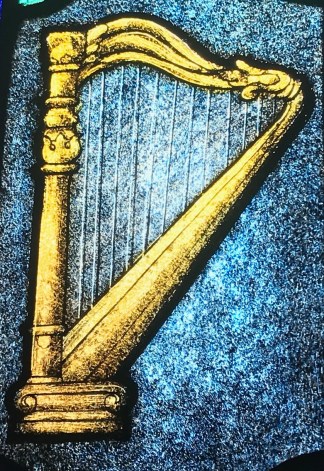 The harp signifies heavenly joy and the music of David. (Psalms 150). Throughout the Old Testament we learn of praises made with musical instruments and today music is very important in our worship services.
The Harp (Heb. kinnor), the national instrument of the Hebrews. The Harp as a Christian Symbol represents music, instruments, joy and worship in praising God. According to Genesis 4:21, the harp was invented by Jubal before the flood of Noah. The harp was used as an accompaniment to songs of cheerfulness as well as of praise to God (Genesis 31:27 ; 1 Samuel 16:23 ; 2 Chr 20:28 ; Psalms 33:2 ; 137:2 ). In Solomon’s time harps were made of almug-trees (1 Kings 10:11 1 Kings 10:12). The soothing effect of the music of the harp is referred to in 1 Samuel 16:16 1 Samuel 16:23 ; 18:10 ; 19:9 . The church in heaven is represented as celebrating the triumphs of the Redeemer “harping with their harps” (Revelation 14:2).[iii]
Jewish historian Josephus records that the harp had ten strings, and that it was played with the fingers. The Harp was used throughout the temple services until the destruction of the Second Temple in 70 CE by the Roman forces of Titus. Using the Biblical scale of ten notes, its music would swell in anthems of praise during the great festivals of the Lord.
The harp will be present even at the end. In Revelation 14:2-3 the apostle John writes- “I heard a sound from heaven like the noise of rushing water and the deep roar of thunder; it was the sound of harpers playing on their harps. There before the throne, and the four living creatures and the elders, they were singing a new song. That song no one could learn except the hundred and forty four thousand who alone from the world had been ransomed.” (vs2-3) The 144,000 are selected by the Lord of hosts to herald the coming of the Messiah.[iv] The harp reminds us of the gift of music and the songs of praise to the Lord.
B: House on the Rock
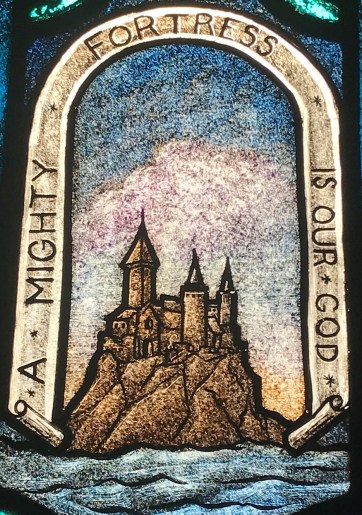 A house or church on a rock is sometimes pictured as securely founded, like those who hear the word of our Lord and do them (Matt. 7:24) and confess him as the Son of the living God-—the rock of faith against which the gates of hell shall not prevail (Matt. 16).
Jesus closes the Sermon on the Mount in Matthew 7:24-27 with these words: 24 “Everyone then who hears these words of mine and acts on them will be like a wise man who built his house on rock. 25 The rain fell, the floods came, and the winds blew and beat on that house, but it did not fall, because it had been founded on rock. 26 And everyone who hears these words of mine and does not act on them will be like a foolish man who built his house on sand. 27 The rain fell, and the floods came, and the winds blew and beat against that house, and it fell—and great was its fall!” This is often called the parable of the wise and foolish builders.
In the present day, there are numerous building codes and processes for building safe buildings for homes and businesses. In Jesus day, there were few such codes and processes. Note that both buildings were built in the fair weather, that the storms came later after they were built and only then was the true quality of craftsmanship shown by the success of the building to withstand or succumb to the storm. The words used to describe the builders are very interesting. The foolish builder is described by the Greek word moros, “foolish”[v], from which the English word “moron” is derived.[vi] On the other hand the Greek word for the wise builder is phronimos, “wise, sensible, thoughtful.”[vii] The contrast between these two words are descriptive of the two builders and the result of the building which they built. Jesus didn’t mention any difference between the skills and resources of the two builders. The only variable He identified was where each chose to build. Jesus noted that, based only on their choices, one man was wise and the other was foolish.
The man who was a wise builder chose the rock as his foundation. It would have been hard to chip into the rock and level off a footing for the house. It may have taken a long time to work around rocky outcrops and to attach the structure to the bedrock. It would have been challenging to build on rocky terrain—it would have taken time, patience and hard work. But the wise man seems to have considered such factors and to have believed it would be worth the effort. Built into the rock, his house could endure the inevitable storms that would come.
The foolish builder was not necessarily a bad man, just apparently a shortsighted and foolish one. Was it because he had too much to do or was in a hurry to have a house and get on with other concerns? We don’t know. He knew about building, but seemingly didn’t consider the foundation to be important enough to invest more time in. His concern appeared to be on the present and on getting the house built quickly. Building on the sandy soil would have been easier. Without taking as much time to prepare the foundation, the entire project was surely completed more swiftly. The foolish builder didn’t seem concerned about the inevitable storms.
Sometime after the men had built their houses, a storm came. Notice that both the wise and foolish builder face the storm. The house built into the rock survived the downpour, but the house on the sand was demolished. Jesus stated, “And great was its fall”—in other words, it was beyond repair.
Jesus was illustrating that we can live wisely or foolishly. It depends on where we lay our foundation. He said that if we pay attention to what He said and follow Him, we will be like the wise builder. We will come through the inevitable storms of life—the trials and difficulties that are part of life—because His teachings are rock-solid principles about how to live successfully. Following Jesus is the best place to build. He provides a solid foundation for our lives, our families, our friendships, our associations and our future.[viii]
Our window also features the words of a famous hymn “A Mighty Fortress is Our God” by Martin Luther, the founder of the protestant church. Luther’s German version is a paraphrase of Psalm 46 which begins, “God is our refuge and strength, a very present help in trouble.” “A Mighty Fortress” may have been written in homage to Luther’s friend Leonhard Kaiser, who was martyred. The first German printing appeared in 1529. While the exact date of composition is uncertain, it may be from this same year. Often called “the true National Hymn of Germany,” the hymn spread rapidly and was sung on the battlefield of Leipzig in 1631 during the Thirty Years’ War (1618-1648). Heinrich Heine, the famous nineteenth-century German poet, called it “the Marseillaise Hymn of the Reformation.”[ix] The house on the rock reminds us to build on the solid foundation and that Jesus is the mighty fortress.
C: Trumpets
 The trumpets are a call to worship and remind us of the Day of Judgment and the Resurrection. They, too, are used in praise. The words, “Ye Praise The Lord,” reflect this symbolism
Many instruments of music are mentioned in the Bible, but the trumpet is the one that stands out prominent amidst them all. In Numbers 10:1-10 there are given express commands for their construction, and throughout the Bible, from the giving of the Law at Sinai down to the sounding of the last trump, and this vision of the seven trumpets, we continually meet with them. What, therefore, may we learn from them? They teach:
GOD HAS A MESSAGE FOR US. Trumpets emit clear, loud notes. In a world before facebook, text, email, or even writing, trumpets were used to communicate with large groups. Trumpets were used to indicate to Israel the begin of seasons of worship – the new year, the new moon, the jubilee, and other occasions when God commanded his people to render special service. And these special messages remind us of God’s great message to mankind, which he has given to us in his Word. The trumpets remind us that he has left a message for us.
The trumpet blast was startling, arousing; its clear, loud note penetrated the dullest ear, and reached those afar off, and forced all to listen. And such message of urgency God’s Word brings to us. It is no mere matter of indifference, but life and death hang upon it. The trumpet note was emphatically the music of war. Jeremiah (Jeremiah 42:14) looks forward to day, “where we shall hear no sound of trumpet.” The hosts of Midian fled in dismay when the blast of Gideon’s trumpet burst on their startled ears. Terror seized on them and made them an easy prey. You might remember when Jericho fell, it was a long trumpet blast and a loud shout that crumbled the walls.
The trumpet also is an instrument of joy. How joyful was the sound when it proclaimed, as so often the trumpet did, the advent of some glad festival, some “acceptable year of the Lord,” the jubilee especially! And in the Feast of Tabernacles the joy was heightened by the frequent sounding of the silver trumpets by the priests. “Blessed are the people that hear the joyful sound” – this is said of God’s message of grace, and such joyful sound is the characteristic note of the gospel.[x] The trumpets remind us of God’s message to us and to joyfully praise the Lord.
III. Conclusion
We love our stained glass windows and we should. But what do people see in us? Does the light of Christ shine through us? The harp reminds us of the gift of music and the songs of praise to the Lord. The house on the rock reminds us to build on the solid foundation- Jesus. The trumpets remind us of God’s message to us and to joyfully praise the Lord. The Bevill Family window reminds us of their faith, generosity, and heritage in our community. The question is will we allow the light of God to shine through us as brightly as it does these windows?
[i] https://www.findagrave.com/memorial/52834755/martha-ellen-bevill
[ii] https://www.findagrave.com/memorial/52833986/james-riley-bevill
[iii] https://www.biblestudytools.com/dictionary/harp/
[iv] http://www.biblesearchers.com/temples/jeremiah11.shtml
[v] Barbara Aland, Kurt Aland, Johannes Karavidopoulas, Carlo M. Martini, and Bruce Metzger, eds., The Greek New Testament (Stuttgart:Deutsche Bibelgesellschaft United Bible Societies, 1994), 119.
[vi] http://www.etymonline.com/index.php?term=moron, accessed 9/25/14.
[vii] Barbara Aland, Kurt Aland, Johannes Karavidopoulas, Carlo M. Martini, and Bruce Metzger, eds., The Greek New Testament (Stuttgart:Deutsche Bibelgesellschaft United Bible Societies, 1994), 195.
[viii] https://bible.org/seriespage/12-storm-warning-matthew-724-29
[ix] https://www.umcdiscipleship.org/resources/history-of-hymns-a-mighty-fortress-is-our-god
[x] http://biblehub.com/sermons/auth/conway/the_trumpet-symbol.htm
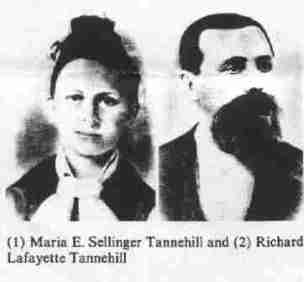 Marie Elizabeth Sellinger Tannehill was Born Jan 3 1859 DEATH Jan 4 1891 (aged 32) BURIAL Jerusalem Cemetery on Hwy 84 west of Winnfield. She was married to Richard Lafayette Tannehill who was said to be a large man (over 6 foot 4 inches) and was a farmer, timberman and politician north of Winnfield. The Winn Parish history book reports that Richard was the Sheriff of Winn Parish from 1874 to 1884. In 1892, he ran for Governor of Louisiana on the Populist ticket and won Winn Parish with 1,001 votes. He was the first elected mayor of Winnfield in 1898. Elizabeth and Richard had 8 children: George Milton Tannehill 1877–1940, Herbert N Tannehill 1879–1961, Clarence Eugene Tannehill 1881–1963, Richard Lafayette Tannehill 1884–1929, Ena Tannehill 1886–1895, Lena Tannehill Pace 1886–1976, Elizabeth Tannehill Walsh 1888–1977, Ella May Tannehill Hardtner 1890–1980. Their 7th child, Elizabeth Tannehill Walsh, often called Bessie, was Don Walsh’s grandmother. The only known relatives of Elizabeth Tannehill active in our church is Don’s widow, Shirley Walsh.
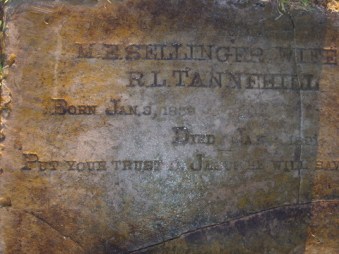 As I was doing my research I wondered why Elizabeth was buried west of town while Lula and Richard are buried in the Winnfield Cemetery. Donovan Hearne Walsh writes this on genealogy.com. “Richard Lafayette’s parents (David & Nancy) came to Winn Parish with them. Three sons died at Tannehill, as did Nancy, and were buried there. Later, the cemetery was moved to Jerusalem Cemetery at the request of the area’s first railroad (Arkansas railroad, later Rock Island RR). At that time period the public wanted railroad transport desperately and accommodated their wishes. These graves were put in one grave marked “Grandmother.” A Nancy M. T. marker was added later. R. L. Tannehill made this move and his remaining brother, Louis Monroe T., objected causing a large disagreement. :.M.T. is buried at Winnfield Cemetery, as is R.L.T. -Donovan Hearne Walsh
 Jesus said, “I am the bread of life.” Heads of wheat symbolize bread, and the Holy Communion. Also the wheat represents the good crop, the faithful, and the tares are the weeds, the wicked. (Matt. 13).
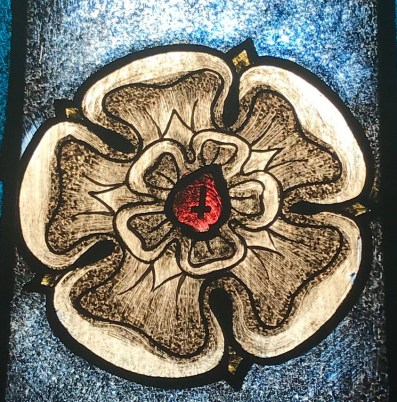 The Christmas Rose represents the Nativity of our Lord. Deep significance is derived from its survival through the centuries’ in spite of snow and storms. It blooms just at Christmas time.
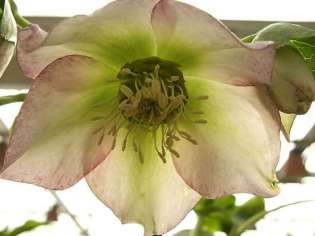 a little Sheppard named Madelon. As Madelon tended to her sheep one cold and wintry night, Wise Men and shepherds passed by Madelon’s snow-covered field bearing gifts for the Christ Child. Following, Madelon saw the Magi present gold, myrrh and frankincense to the baby…even the humble shepherds had brought fruits, honey and doves to give to the babe…but Madelon had nothing, not even a simple flower for the Newborn King. Standing outside the stable where Jesus had been born, poor Madelon wept, wishing that she had a gift she could carry to the infant. A watching Angel, taking pity on Madelon, caused the snow at the feet of the small girl feet to vanish, thus revealing a most beautiful white flower whose petals were tipped with pink, formed by the Angel from the tears which had fallen from the eyes of the little shepherdess. Overjoyed, Madelon presented her gift at the manger of the baby Jesus…her gift of the Christmas Rose.
 The Calvary Cross with the steps of Faith, Hope and Charity is also called the graded cross. The anchor at the left is a symbol of hope “sure and steadfast” (Heb. 6:19). The Bible is again pictured with the Cross. Two other books in the Protestant church call sacred associations to mind—the hymnal and The Book of Worship.
 (Author’s note: This is the manuscript for my message on July 15, 2018 at FUMC Winnfield and is the sixth in my “Windows to the Soul” sermon series expounding on the Christian symbolism present in our church buildings and sanctuary windows at FUMC Winnfield. My sources are listed at the end. Much of this information is from “FUMC Winnfield: Christian Symbolism and History” published in 2012. I decided to publish in case some were absent and would like to read my message.)
 The entire community mourns the passing of Andrew Jackson Gwin, for twenty one years one of the foremost enterprising citizens of Winnfield, died on January 31, 1927 at his home on Main Street. Though Mr. Gwin had been suffering with heart trouble for more than a year, he had not been critically ill for more than thirty days and his death Monday morning while not unexpected was a distinct shock to the entire town because of the high esteem in which he is held.
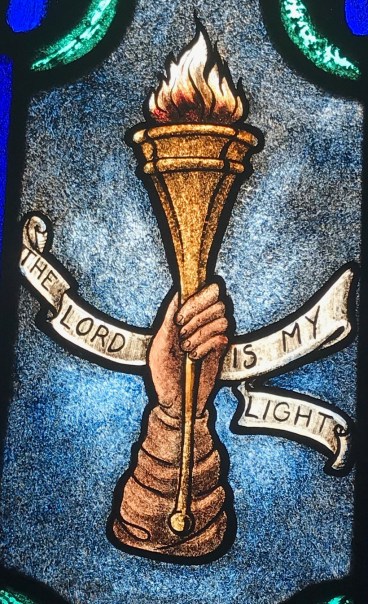 The torch refers to youth’s relation to the past and its obligation to bear the light of truth through the current age to the coming age. “The Lord Is My Light and My Salvation, Whom shall 1 fear?” Psalms 27:1. Jesus said, “I am the light of the world; he who follows me will not walk in darkness, but will have the light of life.” John 8:12.
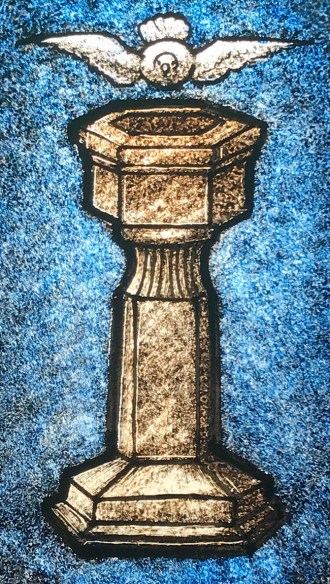 The font is pictured again with the dove of the Holy Spirit lending emphasis to our belief in the two sacraments: Holy Communion and Baptism. Jesus also told his followers to be “innocent as doves” (Matt. 10:16).
 The accessibility to the Bible since the days of the Reformation leads to its being shown open. The Lamp of Learning recalls the scripture, “Thy word is a lamp to my feet and a light to my path.” (Psalms 119:105). To the ancients a lamp was not merely a light for darkness, but also a symbol of intelligence and learning. Today it means wisdom and knowledge.
 (Author’s note: This is the manuscript for my message on July 8, 2018 at FUMC Winnfield and is the fifth in my “Windows to the Soul” sermon series expounding on the Christian symbolism present in our church buildings and sanctuary windows at FUMC Winnfield. My sources are listed at the end. Much of this information is from “FUMC Winnfield: Christian Symbolism and History” published in 2012. I decided to publish in case some were absent and would like to read my message.)
 Today we will focus on Window Number four in honor of Dr. and Mrs F.C. Wren. Funeral services for Dr. Floyd Carr Wren, prominent retired dentist and civic leader, were held at 3 p.m. Friday, February 10, 1967 in the First Methodist Church of Winnfield with the Rev. Richard Walton, pastor, officiating. He was assisted by Rev. Fred Flurry, Sr., and the Rev. R. H. Staples, former pastors. Dr. Wren died at 12:20 p.m. Thursday, February 9, 1967, in a Winnfield hospital following an apparent heart attack. He was 87.
 Funeral services for Mrs. Leta O. Wren, 87, of Winnfield, were held at 3:30 p.m. Friday, June 5, 1970 at the First Methodist Church of Winnfield with Rev. J. C. Skinner and Rev. Robert Gage officiating. Mrs Wren died at 11:15 a.m. Thursday, June 4, 1970, in a Winnfield hospital. She was a native of Caldwell, Ark., but lived in Tennessee during the early years of her life.
 The lion, as king of beasts, represents the royal character of Christ and refers to the opening verses of the Gospel in his reference to John the Baptist, “The voice of one crying in the wilderness . . .” The halo of light, the nimbus, behind the head denotes sanctity.
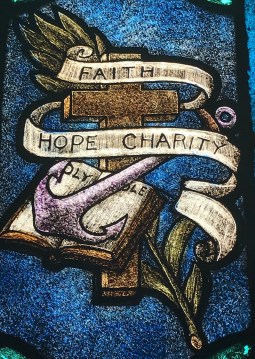 e, and Charity are referred to by Paul in I Cor. 13:13- “And now abideth faith, hope, charity, these three; but the greatest of these is charity.”KJV Faith is belief and trust in the triune God; Hope signifies our promise of eternal life and triumph of truth and justice; Charity, or love, is the center of our religion as taught by Jesus in many ways.
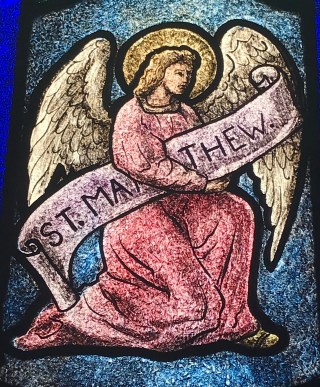 Matthew traced the human lineage of Jesus; therefore, the symbol used for him is a winged man. He emphasized the humanity of Christ. Here again is the nimbus of sanctity.
 (Author’s note: This is the manuscript for my message on July 1, 2018 at FUMC Winnfield and is the fourth in my “Windows to the Soul” sermon series expounding on the Christian symbolism present in our church buildings and sanctuary windows at FUMC Winnfield. My sources are listed at the end. Much of this information is from “FUMC Winnfield: Christian Symbolism and History” published in 2012. I decided to publish in case some were absent and would like to read my message.)
 His wife, Mary Margaret Jackson Dickerson died at 8 a.m. Tuesday, May 19, 1925, age 90 years. Mrs. Dickerson was born in Tennessee February 25th, 1835, moved in early childhood with her parents to Spanish Lake, Natchitoches Parish, where they lived until they moved to Winn Parish, La., in 1859.
 The dove with the olive branch depicts peace, victory, and the expectation of new life. This symbol comes from the account of the cessation of the flood recorded in Genesis 8:11 (Noah sent out the dove to see whether the flood was receding. When the dove returned with a “freshly plucked olive leaf” in her beak, Noah knew that the waters were receding). Hence the olive branch may be said to symbolize deliverance from the hardships of life and a peaceful life with God in the world to come.
 The Bible and the Cross go hand in hand—both represent knowledge of God’s redeeming love. Bible is Greek for “book” and is accepted by Christians as inspired by God with the divine authority on which the Christian religion is based. With 39 Old Testament books, 27 New Testament, it has been called the window through which we see God and the mirror that reflects our true selves. The cross is the focal point of the Bible—everything before Christ set the stage for His coming; the deeds thereafter pay tribute to His power on earth. We spoke extensively about the Bible in the Hyde window. I will focus on the cross this morning
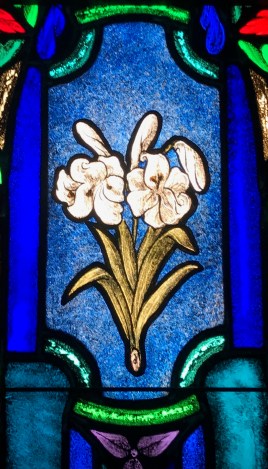 No specific scriptural justification is found for using the Easter Lily but it does aptly describe our hope in the resurrection. When the bulb is buried in the earth, a rebirth comes forth in the beauty of these white lilies with a new bulb for future”
 (Author’s note: This is the complete manuscript and powerpoint pictures for my message at FUMC Winnfield on June 3. This is message #1 of my sermon series “Windows to the Soul” about the church building and stained glass windows at FUMC Winnfield. Much of this information is from “FUMC Winnfield: Christian Symbolism and History” published in 2012. I decided to publish in case some were absent and would like to read my message.)
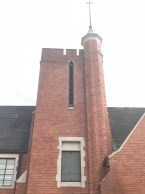 The CHURCH BELLS convey an inner meaning, calling worshipers to come and give the worship and adoration that are due God. The STEEPLE or spire, pointing toward the blue of Heaven, is a silent witness to the one true God whom the people come to worship in the church. Our steeple culminates in the cross at the top, signifying that God loves the world and is reconciling the world unto Himself through the worship, meditation, prayers, and hymns of the people in the church below.
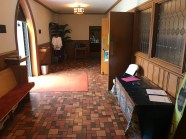 The NARTHEX, or vestibule, is entered by the main entrance stretching across the entire end of the church and prepares the worshiper for entering the sanctuary, separating him from the hustle and bustle of the material world, readying him for the quiet of the House of Worship. The NAVE is from the Latin word “navis”, which means ship. The earliest symbolism
 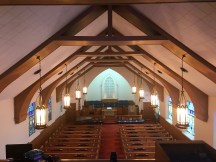 associated with the church is that of a Ship. It returns us to the ark, and the church in comparison is the “ark of safety.” It was natural that the early church buildings were in the form of a ship. So today the nave is the central division of the church in which the congregation is seated.
 we approach the altar, we find at intervals ascending levels and steps leading upward until they reach the altar. We note that the carpet is somewhat worn, reminding us of the many persons who have walked this way —- young couples taking their marriage vows, members of the church family who have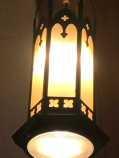
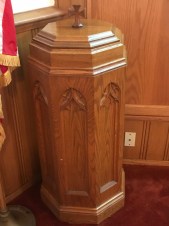 The BAPTISMAL FONT, Latin for “fountain,” is an octagonal receptacle of wood which stands on a pedestal and contains the water for baptism—outward sign of inner change. The cover of the font is crowned with the Cross Pate’e which if formed by four spearheads touching at the center. The eight outer points symbolize the eight Beatitudes and the regeneration of man. The PULPIT, Latin for “raised platform,” is used in delivering sermons. The LECTERN, the desk which stands opposite the pulpit, is usually smaller than the pulpit and used for reading the scripture.
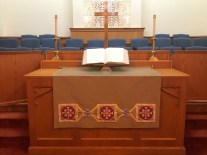 facing the congregation. It may be against the wall or free-standing. At the altar the Holy Communion is consecrated and administered and worship is conducted. Here the hangings, blue cross above the altar, the altar cross, and candles are placed. The HANGINGS, or frontals, are of fine cloth hung on the front of the altar, pulpit and lectern, depicting the divisions of the church year by their color.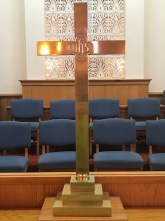
 revkevreflections