
 (Author’s note: This is the manuscript for my message on June 24, 2018 at FUMC Winnfield and is the third in my “Windows to the Soul” sermon series expounding on the Christian symbolism present in our church buildings and sanctuary windows at FUMC Winnfield. I tried to include my sources but my end notes did not transfer well. You’ll find the sources listed at the end. Much of this information is from “FUMC Winnfield: Christian Symbolism and History” published in 2012. I decided to publish in case some were absent and would like to read my message.)
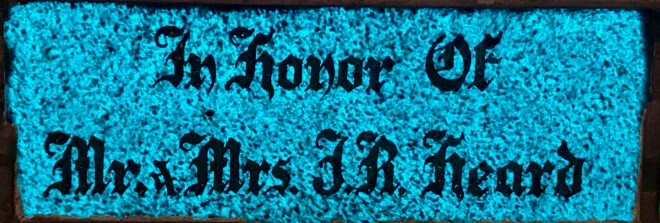
Today we will examine Window Number three (Eagle of St John/Baptismal Font/Winged ox of St. Luke) in Honor of Mr. and Mrs. J.R. Heard. Joseph R Heard joined FUMC October 26, 1911 by Profession of Faith. He died March 30, 1956 when Luther Booth was Pastor. Lena Ewing also joined October 26, 1911 by Profession of Faith. She died January 25, 1974 when Jack Midyett was Pastor. The obituary reads Joseph R. Heard, widely known Winnfield banker and civic leader, died March 30, 1956. Mr. Heard, a native of Shiloh in Union Parish near Bernice, was president of the Bank of Winnfield and Trust Co. He had held that position since 1934.
Mr. Heard came to Winn Parish in 1901 as bookkeeper for a Dodson lumber company. He became vice president and treasurer of the People’s Hardware and Furniture Co. of Winnfield in 1906, a position he still held at the time of his death. In 1907 he was named cashier of the Bank of Winnfield and Trust Co., elevated to vice president in 1916, and named president in 1934. He was treasurer of the First Methodist Church and a member of the church board of stewards. In addition to various church and civic undertakings, he had worked actively with state and southern banking associations.[i]
Lena Ewing Heard died Friday, January 25, 1974 at age 85 in the Winnfield General Hospital following a brief illness. Mrs. Heard, the former Lena Ewing, was the widow of the late Joseph R. Heard, Sr., president of the Bank of Winnfield and Trust Co., a member of the First United Methodist Church, and a native of Texas.
The Heard’s were survived by three sons, J. R. Heard Jr., Robert Heard, and Richard C. Heard. They are the grandparents of Dickie and Buddy Heard. The Heard’s and their family have passed a great tradition of faithfulness to us, as well as a wonderful gift in their beautiful window.
Body
A: The eagle denotes the Evangelist, John.
 Formerly considered to be the Apostle John, he is like an eagle soaring to the Throne of Grace. Reference to the eagle is found in Rev. 4:6-8, and Ezek. 1:10.
“Their faces looked like this: Each of the four had the face of a man, and on the right side each had the face of a lion, and on the left the face of an ox; each also had the face of an eagle.” Ezekiel 1:10[ii]
“Around the throne, and on each side of the throne, are four living creatures, full of eyes in front and behind: 7 the first living creature like a lion, the second living creature like an ox, the third living creature with a face like a human face, and the fourth living creature like a flying eagle.” Rev 4:6-7 These scriptures from Ezekiel and Revelation are usually interpreted to represent the four gospels. Consequently, each of the gospels has been assigned a symbol based on those scriptures. We’ll get to all four symbols eventually but today we begin with the eagle of St. John. St. John was one of the original twelve apostles and has been traditionally taken to be the author of the fourth gospel. The eagle is often used as a symbol representing him. The eagle goes back at least to Jerome’s Commentary on Matthew, which says it signifies “John the Evangelist who, having taken up eagle’s wings and hastening toward higher matters, discusses the Word of God” (55).[iii] John’s Gospel begins with the “lofty” prologue and “rises” to pierce the mysteries of God, such as the relationship between the Father and the Son, and the incarnation: “In the beginning was the Word, the Word was in God’s presence, and the Word was God. He was present to God in the beginning. Through Him all things came into being, and apart from Him nothing came to be” (Jn 1:1-3). And “The Word became flesh and made His dwelling among us, and we have seen His glory: The glory of an only Son coming from the Father filled with enduring love” (Jn 1:14). The Gospel of St. John, unlike the other Gospels, engages the reader with the most profound teachings of our Lord, such as the long discourses Jesus has with Nicodemus and the Samaritan woman, and the beautiful teachings on the Bread of Life and the Good Shepherd. In John, Jesus identifies Himself as “the way, the truth, and the life,” and anyone who embraces Him as such will rise to everlasting life with Him. iv
The eagle of St. John reminds us of his gospel, his lofty teachings and language, and to rise up to meet God.
B: The baptismal font
 “The baptismal font is a vital part of the furnishings of the sanctuary. If the font has seven sides, it represents creation; eight symbolizes the new creation-—regeneration; a circular font indicates the beginning of eternal salvation. A quadrilateral shape speaks silently of people coming from four directions. It is seen on stained glass windows as a symbol of the regeneration of man.”
In her wonderful book, A Place for Baptism, Regina Kuehn reminds readers that the baptismal font’s shape reveals baptismal truth, and the font points to baptism’s key element, water. She invites churches to think more about baptism’s sacramental weight and “the radical nature of our baptismal promises,” than about whether the font is pretty. “The baptistry is an abiding reminder of what we once were, what we now are, and what we shall one day yet be,” she states.
Kuehn says that putting more thought into the design of a baptismal font can “make a permanent visual imprint on our memory… Such a font will not escape our mind and memory; our one-time baptismal event then will develop into a baptismal way of life.” Baptism celebrates becoming that new person. That is why the church’s ritual begins with putting off the old, renouncing sin and the evil powers of the world, and pledging our loyalty to Christ.
In the United Methodist Church, we also believe that in baptism God initiates a covenant with us, announced with the words, “The Holy Spirit works within you, that being born through water and the Spirit, you may be a faithful disciple of Jesus Christ.” This is followed by the sign-act of laying hands on the head, or the signing of the cross on the forehead with oil or water. The word covenant is a biblical word describing God’s initiative in choosing Israel to be a people with a special mission in the world, and Israel’s response in a life of faithfulness. The baptismal covenant calls us to a similar vocation.
Christians have also understood the baptismal covenant in light of Jesus’ baptism. At Jesus’ baptism, God said: “This is my son.” While Jesus’ relation to God as Son is unique, for Christians baptism means that God has also chosen us as daughters and sons, and knows us intimately as a parent.
So the most important things about us, our true identity, is that we are now sons and daughters of God. That is why the introduction to the United Methodist Baptismal Covenant states, “We are incorporated into God’s mighty acts of salvation and given new birth through water and the Spirit.” The introduction also says, “Through the Sacrament of Baptism, we are initiated into Christ’s holy church.”
From the beginning, baptism has been the door through which one enters the church. It was inconceivable to be baptized without joining the fellowship of those who are committed to mature in that faith. As the “Body of Christ” in the world, baptism commissions us to use our gifts to strengthen the church and to transform the world.
You have heard people say, “I was baptized Methodist,” or “I was baptized Presbyterian,” which could mean that in baptism they got their identity papers and that was the end of it. But baptism is not the end. It is the beginning of a lifelong journey of faith. It makes no difference whether you were baptized as an adult or as a child; we all start on that journey at baptism. For the child, the journey begins in the nurturing community of the church, where he or she learns what it means that God loves you. At the appropriate time, the child will make his or her first confession of faith in the ritual the church traditionally calls confirmation. Most often, this is at adolescence or at the time when the person begins to take responsibility for his or her own decisions.
If you experienced God’s grace and were baptized as an adult or received baptism as a child and desire to reaffirm your baptismal vows, the baptismal font marks the journey in the nurturing fellowship of the caring, learning, worshipping, serving congregation.
C: The winged ox
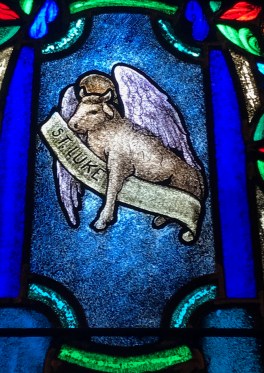 “The winged ox is a symbol of patience and service. The ox is used for St. Luke because he points out the atoning sacrifice of Christ, beginning with the sacrifice of Zachariah in the temple in chapter 1. Luke was the devoted physician of Paul who wrote the gospel of Luke, the book of Acts.” The ox is also a symbol of sacrifice, service and strength.
Oxen were often used in temple sacrifices. For instance, when the Ark of the Covenant was brought to Jerusalem, an ox and a fatling, a cornfed animal, were sacrificed every six steps (2 Sam 6). St. Luke begins his Gospel with the announcement of the birth of St. John the Baptizer to his father, the priest Zechariah, who was offering sacrifice in the Temple (Lk 1). St. Luke also includes the parable of the Prodigal Son, in which the fatted calf is slaughtered, to celebrate the younger son’s return, and foreshadows Jesus’ sacrifice for us to forgive our sins. The winged ox reminds us of the priestly character of our Lord and His sacrifice for our redemption.
St. Luke is believed to be the author of the Gospel that bears his name as well as of the Acts of the Apostles. According to Eusebius, he was probably born in Antioch , Syria of a prosperous Greek family and was trained as a physician. His gospel is considered the most poetic and beautiful of all. He uses the best grammar and the most eloquent and correct Greek of the New Testament. He shows Jesus not as the Jewish Messiah, but as the world’s Savior and Lord. He was a man of prayer, for this gospel is pre-occupied with the power of prayer. He had a high regard for the dignity of women for they played an important part of his writings.
Luke accompanied Paul on his second missionary journey and doubtless had the care of Paul’s health. Luke was with Paul in his last days and final imprisonment in Rome . After writing those famous words to Timothy, “the time of my dissolution is at hand, I have fought a good fight; I have finished my course, I have kept the faith….Paul goes on to say, only Luke is with me. What happened to Luke after Paul’s martyrdom in unsure. But according to a fairly early and widespread tradition, he was unmarried and wrote his Gospel in Greece at Boeotia , where he died at age 84. Because the gospel which bears his name was believed to be an accurate account of the life of Christ and especially of Christ’s birth, Luke became the patron saint of notaries. The ox represents the sacrificial aspect of Jesus’ ministry and the wings remind us that the Gospel of Jesus Christ is to travel throughout the world.iv
Conclusion
People are a lot like glass. Glass can reflect, like a mirror, or transmit light, like a window. Our windows are at their most beautiful when they permit the light to flow through them. The light also shows the flaws and quality of the glass.
Like glass, we need to have the light of God shining through us. Like glass, we can merely reflect, or transmit light. Jesus offers inner light to those who accept him. He is the light of the world according to John 1. We can accept the light, or reject it. If we believe, that inner light becomes ours.
We love our stained glass windows and we should. But what do people see in us? Does the light of Christ shine through? The eagle of St. John reminds us of his soaring prologue and taking the reader to the highest truths of God. The baptismal font reminds us of the regeneration through baptism and the new beginning that baptism offers us. The winged ox reminds us of the steadiness and service of Luke’s faith and the sacrifice that Jesus made for us. The Heard window reminds us of their faith and generosity. The question is will we allow the light of God to shine through us as brightly as it does these windows?
[i] https://www.findagrave.com/memorial/54263776/joseph-ruffin-heard
[ii] http://www.religionfacts.com/eagle
[iii] http://www.christianiconography.info/john.html
[iv] https://catholicexchange.com/the-symbols-of-the-gospel-writers
 (Author’s note: This is the manuscript for my message on June 10, 2018 at FUMC Winnfield and is the second in my “Windows to the Soul” sermon series expounding on the Christian symbolism present in our church buildings and sanctuary windows at FUMC Winnfield. I tried to include my sources but my end notes did not transfer well. You’ll find the sources listed at the end. Much of this information is from “FUMC Winnfield: Christian Symbolism and History” published in 2012. I decided to publish in case some were absent and would like to read my message.)
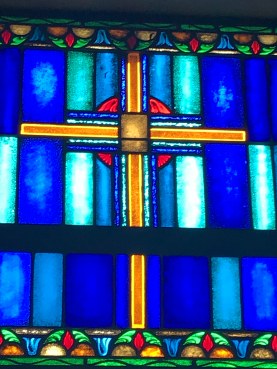 building is window number ten, the lovely portrait of Jesus, the Good Shepherd.
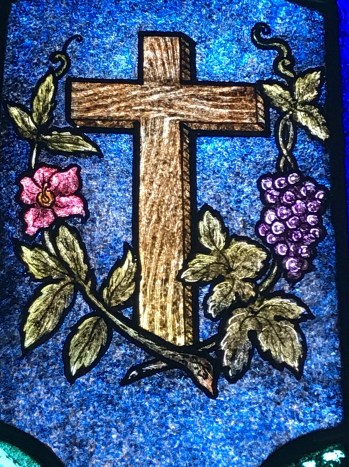 “The Latin cross is the most commonly seen cross. This is the form on which it is said our Lord was crucified. Protestants usually display it as being empty, without the body of Christ, representing Him as the risen and living Christ. The vine is referred to by Christ in John 15:5, ‘I am the vine, you are the branches.’”
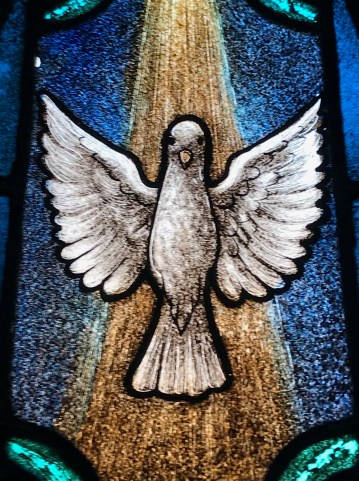 The Dove is the symbol of the Holy Spirit. In all four gospels it is recorded that the Holy Spirit came as a dove from Heaven, making it the most widely recognized symbol of the Spirit. The dove has long been a symbol of peace but the dove has great symbolism in the Bible too. It is mentioned 46 times in Scripture. In addition to its symbolism for the Holy Spirit, the dove was a popular Christian symbol before the cross rose to prominence in the fourth century.
 “The open book often pictured on stained glass windows in the church refers to the Holy Bible. the word of God. The book shown open indicates that the Bible is accessible throughout most of the world in over 1,000 tongues. The Easter Lily, a symbol of purity, is a common symbol of Easter and blooms at that time of the year.” We will look more closely at the symbolism of the Easter Lily in the Dickerson window, so this morning I’m going to focus on the Bible.
 (Author’s note: This is the complete manuscript and powerpoint pictures for my message at FUMC Winnfield on June 3. This is message #1 of my sermon series “Windows to the Soul” about the church building and stained glass windows at FUMC Winnfield. Much of this information is from “FUMC Winnfield: Christian Symbolism and History” published in 2012. I decided to publish in case some were absent and would like to read my message.)
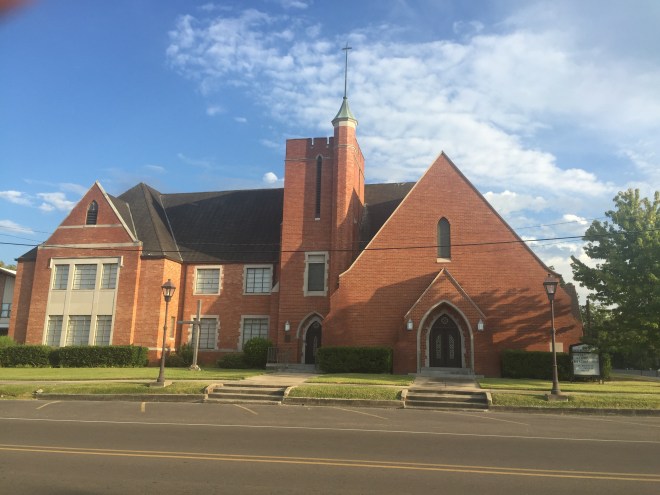
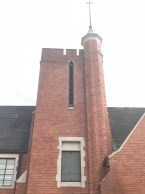 The CHURCH BELLS convey an inner meaning, calling worshipers to come and give the worship and adoration that are due God. The STEEPLE or spire, pointing toward the blue of Heaven, is a silent witness to the one true God whom the people come to worship in the church. Our steeple culminates in the cross at the top, signifying that God loves the world and is reconciling the world unto Himself through the worship, meditation, prayers, and hymns of the people in the church below.
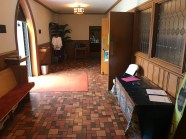 The NARTHEX, or vestibule, is entered by the main entrance stretching across the entire end of the church and prepares the worshiper for entering the sanctuary, separating him from the hustle and bustle of the material world, readying him for the quiet of the House of Worship. The NAVE is from the Latin word “navis”, which means ship. The earliest symbolism
 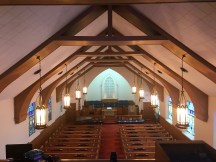 associated with the church is that of a Ship. It returns us to the ark, and the church in comparison is the “ark of safety.” It was natural that the early church buildings were in the form of a ship. So today the nave is the central division of the church in which the congregation is seated.
 we approach the altar, we find at intervals ascending levels and steps leading upward until they reach the altar. We note that the carpet is somewhat worn, reminding us of the many persons who have walked this way —- young couples taking their marriage vows, members of the church family who have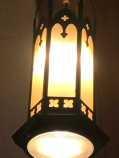
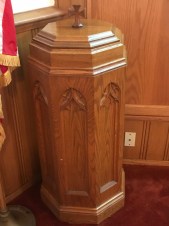 The BAPTISMAL FONT, Latin for “fountain,” is an octagonal receptacle of wood which stands on a pedestal and contains the water for baptism—outward sign of inner change. The cover of the font is crowned with the Cross Pate’e which if formed by four spearheads touching at the center. The eight outer points symbolize the eight Beatitudes and the regeneration of man. The PULPIT, Latin for “raised platform,” is used in delivering sermons. The LECTERN, the desk which stands opposite the pulpit, is usually smaller than the pulpit and used for reading the scripture.
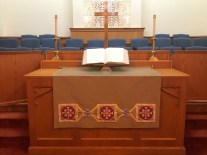 facing the congregation. It may be against the wall or free-standing. At the altar the Holy Communion is consecrated and administered and worship is conducted. Here the hangings, blue cross above the altar, the altar cross, and candles are placed. The HANGINGS, or frontals, are of fine cloth hung on the front of the altar, pulpit and lectern, depicting the divisions of the church year by their color.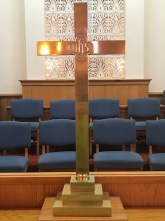
 (Author’s note: this article originally appeared in the June Edition of the FUMC Winnfield newsletter The Cross and Tower)


 (Author’s note: this is the introduction to my sermon “Eating With Ghosts” from Luke 24:36-48 on April 15, 2018 at FUMCWinnfield)
 (Author’s note: This is the conclusion of my Easter message “Surprise in a Graveyard” at FUMC Winnfield April 1, 2018. I have the source for this story listed as Rosemary Kadrmas in Jeff Cavins, et.al, Amazing Grace for the Catholic Heart (West Chester, PA: Ascension Press, LLC, 2003), pp. 211-212.)
 (Author’s note: this article originally appeared in the April edition of “The Cross and Tower” newsletter from FUMC Winnfield. The entire newsletter can be viewed at
  (Author’s note: this is the conclusion of my message titled “Will You Join the Parade” on March 25, 2018 [Palm Sunday] at FUMC Winnfield.)
 Author’s note: every week I run across good stories and illustrations that I just don’t have enough time for in my sermon. Today’s story is a challenging one that was left on the cutting room floor for my sermon on March 18, 2018 from Jeremiah 31:31-34. I have the source listed as “Adapted from Andrew H. Rogers,
  revkevreflections