
(Author’s note: This is the manuscript for my message on August 12, 2018 at FUMC Winnfield and is the tenth in my “Windows to the Soul” sermon series expounding on the Christian symbolism present in our church buildings and sanctuary windows at FUMC Winnfield. My sources are listed at the end. Much of this information is from “FUMC Winnfield: Christian Symbolism and History” published in 2012. I decided to publish in case some were absent and would like to read my message.)
I. Introduction
Over the last weeks we have been looking at the reminders of God all around in the symbolism of our church building and stained glass windows. Today we come to window number 9 in memory of James and Ella Russell and window number 10 in memory of Mr and Mrs N.M. Jackson.
II. Body
A. Balcony Cross
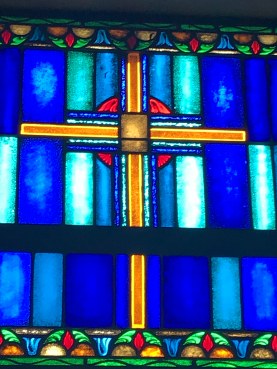
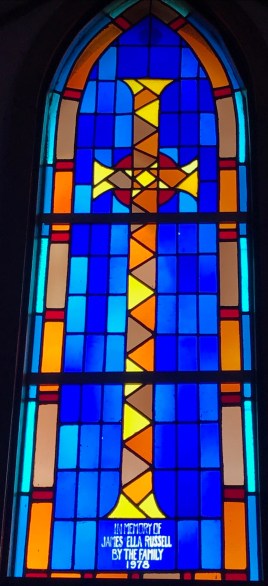 Window Number Nine (in memory of James and Ella Russell) in the Balcony is divided by the cross, seen more distinctly from the outside of the church, is a contrast in its simplicity and carries out the arched theme seen throughout the sanctuary.
James G. Russell, Sr was born June 15, 1879 in Blanchard, Isabella County, Michigan. He died Oct 11, 1967 (aged 88) in Winnfield.
His obituary reads: Jame G. Russell, Sr., 88, retired accountant of Winnfield, died at 11:35 p.m. Wednesday, October 11, 1967 in a local hospital after a lengthy illness. The deceased was a native of Blanchard, Michigan, but moved with the Tremone Lumber Company to Winnfield 65 years ago. For the past several years he was employed as bookkeeper for a local wholesale grocery.
Mr. Russell was an active member of the First Methodist Church where he served on the board of stewards for many years. He had taught Sunday School classes, all ages ranging from 6 to 60 years.
Funeral services were conducted in First Methodist Church with Rev. Richard Walton 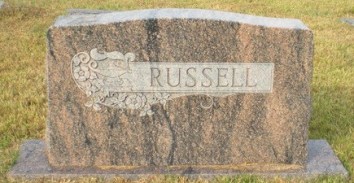 officiating, assisted by Rev. R. H. Staples and Rev. Edgar Dufrense. Survivors include three sons, J. G. Russell, Jr., of Winnfield, Lawrence Russell of Alexandria, and Donald Russell of Bossier City; three daughters, Mrs. Max Allen of Winnfield, Mrs. Clyde Corley, Bastrop, and Mrs. Charles Dark of Cleveland, Texas; 10 grandchildren and 13 great grandchildren.[i]
Clara Ella Gibson Russell was born Feb 22, 1886. She died Dec 6, 1954 (aged 68). She is buried in Winnfield Cemetery.[ii] Rusty and Ellen Russell are James and Clara’s grandchildren.
All of the windows are beautiful, but this is window is one of my favorites. It is the most visible window to me from the pulpit while being hidden from many of you in the pews. It’s simple image of the cross is a reminder to me to always center what I do and say on Jesus and what he has done for us.
As many of you know, I was not raised a Methodist. I did not set foot in a Methodist church until I was in college. When I was deciding if I wanted to be a Methodist and was called to be a United Methodist pastor, a man named Dan Solomon was the Bishop in Louisiana from 1996-2000. I met with Bishop Solomon in his office in Baton Rouge and we had an honest and fruitful conversation. It is one of the reasons I am standing here this morning.
Bishop Solomon was an excellent preacher and many of the times I heard him speak, he reminded his listeners to “keep the main thing, the main thing.” The Russel window is a constant reminder to me to keep Jesus and the cross the main thing in my life and preaching, that, like the arched theme and cross, I might point others to Jesus.
The lone sheep window in the stairwell near the Sanctuary in honor of James’ son, Jim. This window was made by Betty Lawson’s sister and was given by the church and the community in October of 1993 for Jim’s 80th birthday. The Russell windows reminds us of their faith, to keep the main thing the main thing, and to point others to Jesus.
B.Good Shepherd Window
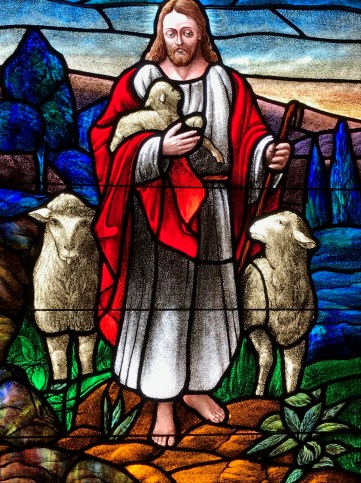 Window Number Ten, lighted throughout the night, depicts Christ as the good shepherd. Recalling the beautiful passages of Psalms 23, we see the depth of Christ’s words, “I am the good shepherd. The good shepherd lays clown his life for the sheep.” (John 10:11). The life of service that Jesus lived and his sacrificial death have inspired the figure of a stalwart young man carrying a lamb. On the walls of the catacombs of Rome where the early Christians went to escape the Roman soldiers. there is found over 150 times the picture of the shepherd, reminding the faithful scattered sheep of their Good Shepherd whose care was unfailing at all times.
The good shepherd window is in memory of Mr. and Mrs. N.M. Jackson. Napoleon M. Jackson was born Feb 16, 1870 in Ruston. He died Jun 4 ,1939 (aged 69) in Winnfield. He is buried in the Winnfield Cemetery.
His obituary reads: N. M. Jackson, 69, prominent citizen of Winnfield, died suddenly 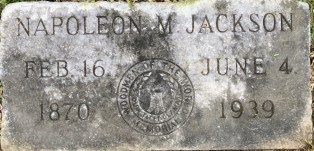 Sunday morning at about 4:30 as he was about his usual task of caring for his dairy cows. His grandson, Harold DeBray, who assists him during vacation time, seeing milk flowing down the hallway of the barn, went to see the cause and found Mr. Jackson dead.
Mr. and Mrs. Jackson moved to Winnfield in November, 1909, coming from the old Jackson farm near Ruston, where Mr. Jackson was born and reared. Here they reared and educated their family, taking an active part in the religious and civic life of the community. Mr. Jackson had been a member of the Methodist Church since a youth and had been a member of the Woodmen of the World for many years.
Last rites were conducted from the Methodist Church Monday morning with the pastor, Rev. G. A Morgan, officiating. He was assisted by the Rev. Alwin Stokes, pastor of the First Presbyterian Church, and Rev. W. T. Strain, Baptist minister of Simsboro. The floral offering, coming from friends throughout the state, was one of the largest ever witnessed in Winnfield, attesting to the esteem in which the family is held. Published in The Winn Parish Enterprise (Winnfield, LA), June 8, 1939[iii]
Ella McIntosh Jackson was born Mar 23, 1874 in Waxahachie, Texas. She died Nov 25, 1960 at the age of 86 in Winnfield.
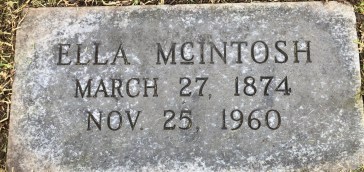 Her obituary reads: Mrs. N. M. Jackson, 86, died at a local hospital early Friday morning, November 25, 1960. She had been in failing health for the past two years. Last rites were conducted at the First Methodist Church with the pastor, Rev. R. H. Staples, officiating. He was assisted by Dr. W. L. Holcomb of the First Baptist Church and by Rev. P. M. Carraway of Shreveport, former pastor of Winnfield. Burial was in the Winnfield Cemetery under direction of Southern Funeral Home.
The deceased was the former Miss Ella Olyce McIntosh, born in Waxahachie, Texas, on

Mr. and Mrs. N.M. Jackson
March 27, 1874. She was active in the religious and civic life of Winnfield and took a leading part in various clubs and groups. Mrs. Jackson was a charter member of the Methodist WSCS and served as its president for four years. She was also a charter member of the Readers Review Club, the Garden Club, and Methodist Orphanage Society, of which she served as president many years. Other organizations of which she was a charter member included the P. T. A., and the Delphians.
Mr and Mrs Jackson had six children. They are the grandparents of John Glen Jackson and great grandparents of Jan Shell Beville and Fran Shell Walton. Published in The Winn Parish Enterprise News-American Winnfield, LA), December 1, 1960[iv]
The most represented image in catacomb art is of Christ as the Good Shepherd. In the ancient world sheep provided wool, milk, cheese and meat and the shepherd of the sheep was the person who led the sheep to good pastures, risked his life to protect them from wild animals, gave help to the sheep who were injured, kept an accurate account of them, looked for those who were lost and made sure they were safe at night
The kings of Israel were expected by God to be shepherds of His people (II Samuel 5:2) and the New Testament word for “pastor” from the Latin pastorem literally means “shepherd. The sculptures and images are meant to evoke passages in Scripture about Christ as the shepherd who goes after the lost sheep, finds it and brings it home as well as the shepherd who protects, pastures and lays down his life for his flock:
In John 10:11-15 Jesus says 11 “I am the good shepherd. The good shepherd lays down his life for the sheep. 12 The hired hand, who is not the shepherd and does not own the sheep, sees the wolf coming and leaves the sheep and runs away—and the wolf snatches them and scatters them. 13 The hired hand runs away because a hired hand does not care for the sheep. 14 I am the good shepherd. I know my own and my own know me, 15 just as the Father knows me and I know the Father. And I lay down my life for the sheep. The early Christians used the Biblical metaphor of the Good Shepherd to show the redeeming work of Christ and of His care for believers—Jew AND Gentile.[v]
If you are like most people today, chances are you do not know any shepherds. Think about their job. First, to better understand the purpose of a shepherd during the times of Jesus, it is helpful to realize that sheep are utterly defenseless and totally dependent upon the shepherd. Sheep are always subject to danger and must always be under the watchful eye of the shepherd as they graze. Rushing walls of water down the valleys from sudden, heavy rainfalls may sweep them away, robbers may steal them, and wolves may attack the flock. David tells how he killed a lion and a bear while defending his father’s flock as a shepherd boy (1 Samuel 17:36). Driving snow in winter, blinding dust and burning sands in summer, long, lonely hours each day—all these the shepherd patiently endures for the welfare of the flock. In fact, shepherds were frequently subjected to grave danger, sometimes even giving their lives to protect their sheep.[vi]
A shepherd tended his flock day and night. He would gather the sheep into a sheepfold at night for their protection. The sheepfold was a pen, a cave, or an area backed by stone walls. Since there were no doors, the shepherd would often sleep or sit in the opening, ready to guard his sheep from harm.
The good shepherd was different than a hired hand who might run away in the face of danger. The good shepherd would stay and defend them. He had a genuine loving concern for what belonged to him. In chapter 10, Jesus illustrates how the shepherd cares for his flock, protecting them from weather, thieves, and predatory animals. He loved and shielded them and if necessary, he would lay down his life for them. [vii]
A shepherd knows his sheep well. There is a personal relationship between Jesus and his followers. Jesus knows each of us by name. On the other hand, we respond to his voice and do not follow the voice of strangers who may lead us to harm. When Jesus gave Peter the responsibility of leading his Church, he again used shepherd imagery. He told Peter, “Feed my lambs. . . . Tend my sheep. . . . Feed my sheep” (John 21:15-17). The image of shepherds is that they are kind, loving, patient, strong, and self-sacrificing. They are a good image for Jesus. And sheep, who can be rather stupid and foolish creatures, are a good symbol for us![viii] The good shepherd window reminds us that Jesus is the good shepherd who laid down his life for us.
III. Conclusion
We love our stained glass windows and we should. But what do people see in us? Does the light of Christ shine through us? The balcony cross reminds us of the Russell family and to keep Jesus the main thing. The good Shepherd window reminds us of the Jackson family and that Jesus is the good shepherd who lays down his life for us. The question is will we allow the light of God to shine through us as brightly as it does these windows?
[i] https://www.findagrave.com/memorial/58955130/james-g.-russell
[ii] https://www.findagrave.com/memorial/27341643/clara-ella-russell
[iii] https://www.findagrave.com/memorial/54395312/napoleon-m.-jackson
[iv] https://www.findagrave.com/memorial/54395075/ella-jackson
[v] https://earlychurchhistory.org/christian-symbols/symbol-of-christ-as-good-shepherd/
[vi] https://www.gotquestions.org/Good-Shepherd.html
[vii] https://www.allaboutjesuschrist.org/jesus-the-good-shepherd.htm
[viii] https://www.loyolapress.com/our-catholic-faith/scripture-and-tradition/jesus-and-the-new-testament/who-do-you-say-that-i-am-names-for-jesus/the-good-shepherd
 (Author’s note: This is the manuscript for my message on August 5, 2018 at FUMC Winnfield and is the ninth in my “Windows to the Soul” sermon series expounding on the Christian symbolism present in our church buildings and sanctuary windows at FUMC Winnfield. My sources are listed at the end. Much of this information is from “FUMC Winnfield: Christian Symbolism and History” published in 2012. I decided to publish in case some were absent and would like to read my message.)
 The lyre again represents praise or worship. Psalms 33:2 reads, “Praise the Lord with the lyre, make melody to Him with the harp of ten strings!”
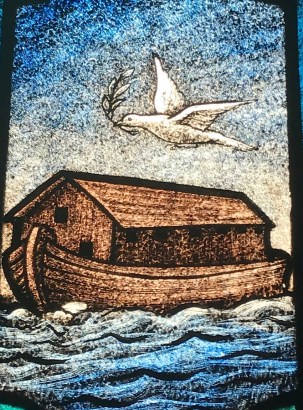 The dove with olive branch is a symbol of peace. When Noah’s ark is used, it stands for salvation or more particularly the salvation which the Church affords. Thus it is often used as a symbol of the Church.
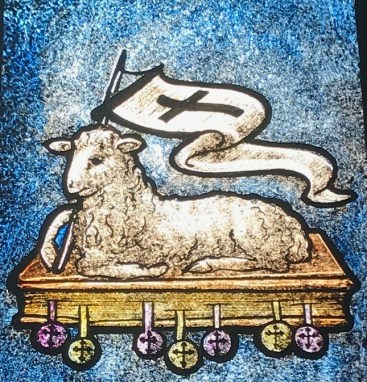 According to John 1:29, when John the Baptist saw Jesus, he said, “Behold, the Lamb of God.” This and a similar statement in John 1:36 have brought into being two of our most meaningful symbols of Jesus Christ. One form of this symbol shows a lamb reclining on the Book of the Seven Seals mentioned in Rev. 5:1. The Easter banner symbolizes Christ’s victory over death.
 (Author’s note: This is the manuscript for my message on July 29, 2018 at FUMC Winnfield and is the eighth in my “Windows to the Soul” sermon series expounding on the Christian symbolism present in our church buildings and sanctuary windows at FUMC Winnfield. My sources are listed at the end. Much of this information is from “FUMC Winnfield: Christian Symbolism and History” published in 2012. I decided to publish in case some were absent and would like to read my message.)
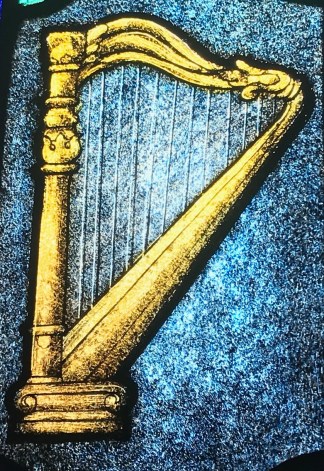 The harp signifies heavenly joy and the music of David. (Psalms 150). Throughout the Old Testament we learn of praises made with musical instruments and today music is very important in our worship services.
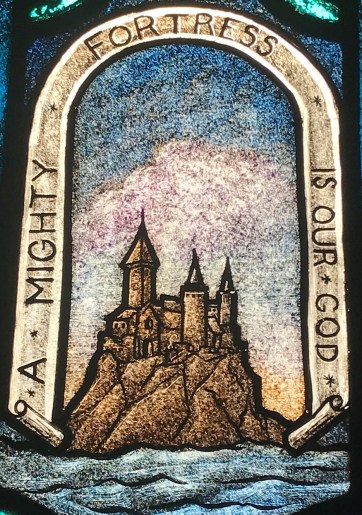 A house or church on a rock is sometimes pictured as securely founded, like those who hear the word of our Lord and do them (Matt. 7:24) and confess him as the Son of the living God-—the rock of faith against which the gates of hell shall not prevail (Matt. 16).
 The trumpets are a call to worship and remind us of the Day of Judgment and the Resurrection. They, too, are used in praise. The words, “Ye Praise The Lord,” reflect this symbolism
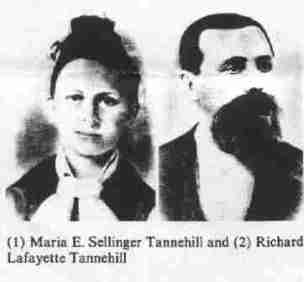 Marie Elizabeth Sellinger Tannehill was Born Jan 3 1859 DEATH Jan 4 1891 (aged 32) BURIAL Jerusalem Cemetery on Hwy 84 west of Winnfield. She was married to Richard Lafayette Tannehill who was said to be a large man (over 6 foot 4 inches) and was a farmer, timberman and politician north of Winnfield. The Winn Parish history book reports that Richard was the Sheriff of Winn Parish from 1874 to 1884. In 1892, he ran for Governor of Louisiana on the Populist ticket and won Winn Parish with 1,001 votes. He was the first elected mayor of Winnfield in 1898. Elizabeth and Richard had 8 children: George Milton Tannehill 1877–1940, Herbert N Tannehill 1879–1961, Clarence Eugene Tannehill 1881–1963, Richard Lafayette Tannehill 1884–1929, Ena Tannehill 1886–1895, Lena Tannehill Pace 1886–1976, Elizabeth Tannehill Walsh 1888–1977, Ella May Tannehill Hardtner 1890–1980. Their 7th child, Elizabeth Tannehill Walsh, often called Bessie, was Don Walsh’s grandmother. The only known relatives of Elizabeth Tannehill active in our church is Don’s widow, Shirley Walsh.
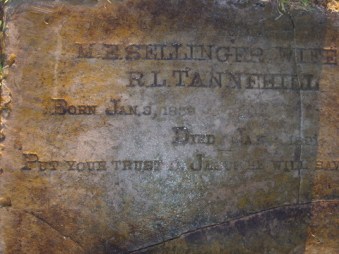 As I was doing my research I wondered why Elizabeth was buried west of town while Lula and Richard are buried in the Winnfield Cemetery. Donovan Hearne Walsh writes this on genealogy.com. “Richard Lafayette’s parents (David & Nancy) came to Winn Parish with them. Three sons died at Tannehill, as did Nancy, and were buried there. Later, the cemetery was moved to Jerusalem Cemetery at the request of the area’s first railroad (Arkansas railroad, later Rock Island RR). At that time period the public wanted railroad transport desperately and accommodated their wishes. These graves were put in one grave marked “Grandmother.” A Nancy M. T. marker was added later. R. L. Tannehill made this move and his remaining brother, Louis Monroe T., objected causing a large disagreement. :.M.T. is buried at Winnfield Cemetery, as is R.L.T. -Donovan Hearne Walsh
 Jesus said, “I am the bread of life.” Heads of wheat symbolize bread, and the Holy Communion. Also the wheat represents the good crop, the faithful, and the tares are the weeds, the wicked. (Matt. 13).
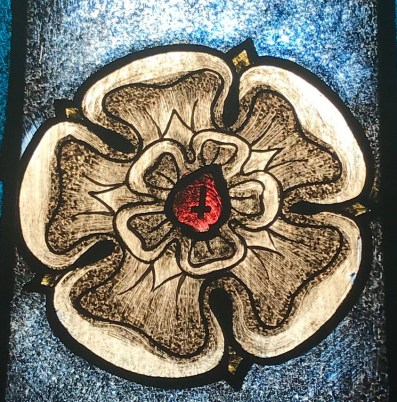 The Christmas Rose represents the Nativity of our Lord. Deep significance is derived from its survival through the centuries’ in spite of snow and storms. It blooms just at Christmas time.
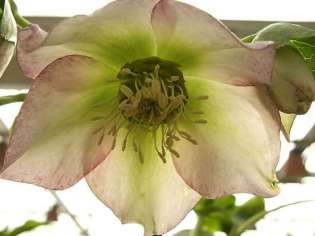 a little Sheppard named Madelon. As Madelon tended to her sheep one cold and wintry night, Wise Men and shepherds passed by Madelon’s snow-covered field bearing gifts for the Christ Child. Following, Madelon saw the Magi present gold, myrrh and frankincense to the baby…even the humble shepherds had brought fruits, honey and doves to give to the babe…but Madelon had nothing, not even a simple flower for the Newborn King. Standing outside the stable where Jesus had been born, poor Madelon wept, wishing that she had a gift she could carry to the infant. A watching Angel, taking pity on Madelon, caused the snow at the feet of the small girl feet to vanish, thus revealing a most beautiful white flower whose petals were tipped with pink, formed by the Angel from the tears which had fallen from the eyes of the little shepherdess. Overjoyed, Madelon presented her gift at the manger of the baby Jesus…her gift of the Christmas Rose.
 The Calvary Cross with the steps of Faith, Hope and Charity is also called the graded cross. The anchor at the left is a symbol of hope “sure and steadfast” (Heb. 6:19). The Bible is again pictured with the Cross. Two other books in the Protestant church call sacred associations to mind—the hymnal and The Book of Worship.
 (Author’s note: This is the manuscript for my message on July 15, 2018 at FUMC Winnfield and is the sixth in my “Windows to the Soul” sermon series expounding on the Christian symbolism present in our church buildings and sanctuary windows at FUMC Winnfield. My sources are listed at the end. Much of this information is from “FUMC Winnfield: Christian Symbolism and History” published in 2012. I decided to publish in case some were absent and would like to read my message.)
 The entire community mourns the passing of Andrew Jackson Gwin, for twenty one years one of the foremost enterprising citizens of Winnfield, died on January 31, 1927 at his home on Main Street. Though Mr. Gwin had been suffering with heart trouble for more than a year, he had not been critically ill for more than thirty days and his death Monday morning while not unexpected was a distinct shock to the entire town because of the high esteem in which he is held.
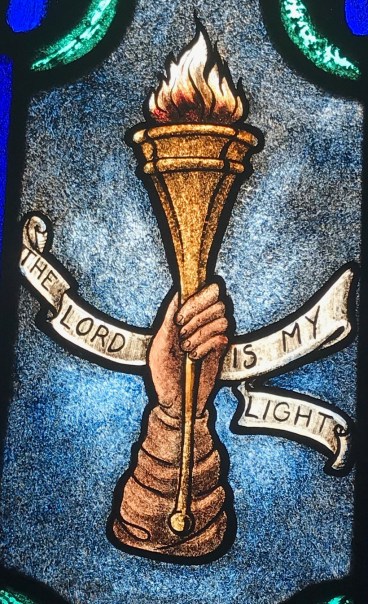 The torch refers to youth’s relation to the past and its obligation to bear the light of truth through the current age to the coming age. “The Lord Is My Light and My Salvation, Whom shall 1 fear?” Psalms 27:1. Jesus said, “I am the light of the world; he who follows me will not walk in darkness, but will have the light of life.” John 8:12.
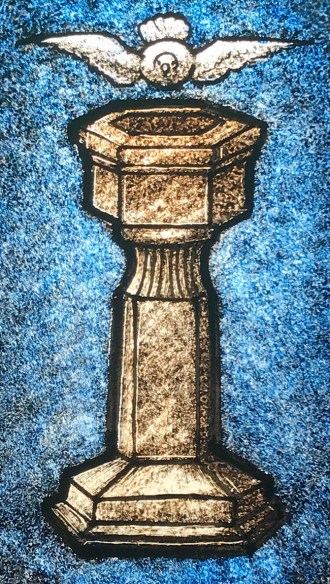 The font is pictured again with the dove of the Holy Spirit lending emphasis to our belief in the two sacraments: Holy Communion and Baptism. Jesus also told his followers to be “innocent as doves” (Matt. 10:16).
 The accessibility to the Bible since the days of the Reformation leads to its being shown open. The Lamp of Learning recalls the scripture, “Thy word is a lamp to my feet and a light to my path.” (Psalms 119:105). To the ancients a lamp was not merely a light for darkness, but also a symbol of intelligence and learning. Today it means wisdom and knowledge.
 (Author’s note: This is the manuscript for my message on July 8, 2018 at FUMC Winnfield and is the fifth in my “Windows to the Soul” sermon series expounding on the Christian symbolism present in our church buildings and sanctuary windows at FUMC Winnfield. My sources are listed at the end. Much of this information is from “FUMC Winnfield: Christian Symbolism and History” published in 2012. I decided to publish in case some were absent and would like to read my message.)
 Today we will focus on Window Number four in honor of Dr. and Mrs F.C. Wren. Funeral services for Dr. Floyd Carr Wren, prominent retired dentist and civic leader, were held at 3 p.m. Friday, February 10, 1967 in the First Methodist Church of Winnfield with the Rev. Richard Walton, pastor, officiating. He was assisted by Rev. Fred Flurry, Sr., and the Rev. R. H. Staples, former pastors. Dr. Wren died at 12:20 p.m. Thursday, February 9, 1967, in a Winnfield hospital following an apparent heart attack. He was 87.
 Funeral services for Mrs. Leta O. Wren, 87, of Winnfield, were held at 3:30 p.m. Friday, June 5, 1970 at the First Methodist Church of Winnfield with Rev. J. C. Skinner and Rev. Robert Gage officiating. Mrs Wren died at 11:15 a.m. Thursday, June 4, 1970, in a Winnfield hospital. She was a native of Caldwell, Ark., but lived in Tennessee during the early years of her life.
 The lion, as king of beasts, represents the royal character of Christ and refers to the opening verses of the Gospel in his reference to John the Baptist, “The voice of one crying in the wilderness . . .” The halo of light, the nimbus, behind the head denotes sanctity.
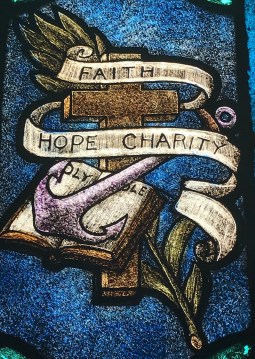 e, and Charity are referred to by Paul in I Cor. 13:13- “And now abideth faith, hope, charity, these three; but the greatest of these is charity.”KJV Faith is belief and trust in the triune God; Hope signifies our promise of eternal life and triumph of truth and justice; Charity, or love, is the center of our religion as taught by Jesus in many ways.
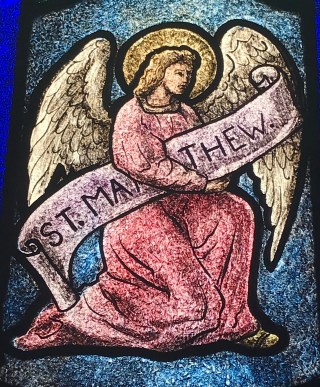 Matthew traced the human lineage of Jesus; therefore, the symbol used for him is a winged man. He emphasized the humanity of Christ. Here again is the nimbus of sanctity.
 (Author’s note: This is the manuscript for my message on July 1, 2018 at FUMC Winnfield and is the fourth in my “Windows to the Soul” sermon series expounding on the Christian symbolism present in our church buildings and sanctuary windows at FUMC Winnfield. My sources are listed at the end. Much of this information is from “FUMC Winnfield: Christian Symbolism and History” published in 2012. I decided to publish in case some were absent and would like to read my message.)
 His wife, Mary Margaret Jackson Dickerson died at 8 a.m. Tuesday, May 19, 1925, age 90 years. Mrs. Dickerson was born in Tennessee February 25th, 1835, moved in early childhood with her parents to Spanish Lake, Natchitoches Parish, where they lived until they moved to Winn Parish, La., in 1859.
 The dove with the olive branch depicts peace, victory, and the expectation of new life. This symbol comes from the account of the cessation of the flood recorded in Genesis 8:11 (Noah sent out the dove to see whether the flood was receding. When the dove returned with a “freshly plucked olive leaf” in her beak, Noah knew that the waters were receding). Hence the olive branch may be said to symbolize deliverance from the hardships of life and a peaceful life with God in the world to come.
 The Bible and the Cross go hand in hand—both represent knowledge of God’s redeeming love. Bible is Greek for “book” and is accepted by Christians as inspired by God with the divine authority on which the Christian religion is based. With 39 Old Testament books, 27 New Testament, it has been called the window through which we see God and the mirror that reflects our true selves. The cross is the focal point of the Bible—everything before Christ set the stage for His coming; the deeds thereafter pay tribute to His power on earth. We spoke extensively about the Bible in the Hyde window. I will focus on the cross this morning
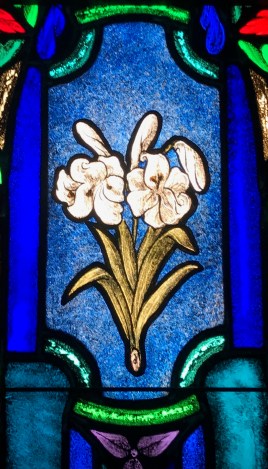 No specific scriptural justification is found for using the Easter Lily but it does aptly describe our hope in the resurrection. When the bulb is buried in the earth, a rebirth comes forth in the beauty of these white lilies with a new bulb for future”
 (Author’s note: This is the manuscript for my message on June 24, 2018 at FUMC Winnfield and is the third in my “Windows to the Soul” sermon series expounding on the Christian symbolism present in our church buildings and sanctuary windows at FUMC Winnfield. I tried to include my sources but my end notes did not transfer well. You’ll find the sources listed at the end. Much of this information is from “FUMC Winnfield: Christian Symbolism and History” published in 2012. I decided to publish in case some were absent and would like to read my message.)
 Formerly considered to be the Apostle John, he is like an eagle soaring to the Throne of Grace. Reference to the eagle is found in Rev. 4:6-8, and Ezek. 1:10.
 “The baptismal font is a vital part of the furnishings of the sanctuary. If the font has seven sides, it represents creation; eight symbolizes the new creation-—regeneration; a circular font indicates the beginning of eternal salvation. A quadrilateral shape speaks silently of people coming from four directions. It is seen on stained glass windows as a symbol of the regeneration of man.”
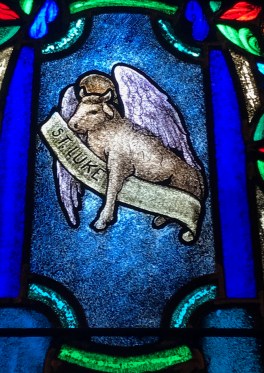 “The winged ox is a symbol of patience and service. The ox is used for St. Luke because he points out the atoning sacrifice of Christ, beginning with the sacrifice of Zachariah in the temple in chapter 1. Luke was the devoted physician of Paul who wrote the gospel of Luke, the book of Acts.” The ox is also a symbol of sacrifice, service and strength.
 (Author’s note: This is the manuscript for my message on June 10, 2018 at FUMC Winnfield and is the second in my “Windows to the Soul” sermon series expounding on the Christian symbolism present in our church buildings and sanctuary windows at FUMC Winnfield. I tried to include my sources but my end notes did not transfer well. You’ll find the sources listed at the end. Much of this information is from “FUMC Winnfield: Christian Symbolism and History” published in 2012. I decided to publish in case some were absent and would like to read my message.)
 building is window number ten, the lovely portrait of Jesus, the Good Shepherd.
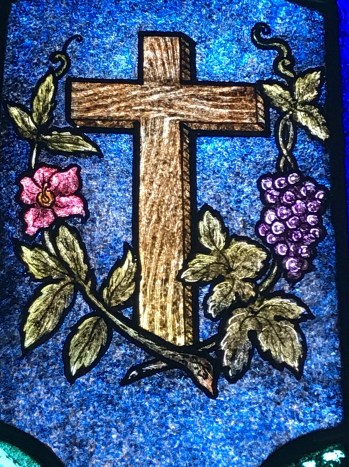 “The Latin cross is the most commonly seen cross. This is the form on which it is said our Lord was crucified. Protestants usually display it as being empty, without the body of Christ, representing Him as the risen and living Christ. The vine is referred to by Christ in John 15:5, ‘I am the vine, you are the branches.’”
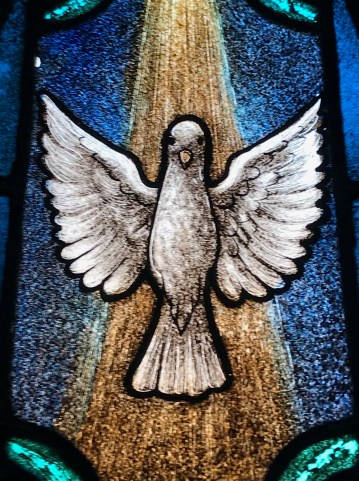 The Dove is the symbol of the Holy Spirit. In all four gospels it is recorded that the Holy Spirit came as a dove from Heaven, making it the most widely recognized symbol of the Spirit. The dove has long been a symbol of peace but the dove has great symbolism in the Bible too. It is mentioned 46 times in Scripture. In addition to its symbolism for the Holy Spirit, the dove was a popular Christian symbol before the cross rose to prominence in the fourth century.
 “The open book often pictured on stained glass windows in the church refers to the Holy Bible. the word of God. The book shown open indicates that the Bible is accessible throughout most of the world in over 1,000 tongues. The Easter Lily, a symbol of purity, is a common symbol of Easter and blooms at that time of the year.” We will look more closely at the symbolism of the Easter Lily in the Dickerson window, so this morning I’m going to focus on the Bible.
 (Author’s note: This is the complete manuscript and powerpoint pictures for my message at FUMC Winnfield on June 3. This is message #1 of my sermon series “Windows to the Soul” about the church building and stained glass windows at FUMC Winnfield. Much of this information is from “FUMC Winnfield: Christian Symbolism and History” published in 2012. I decided to publish in case some were absent and would like to read my message.)
 The CHURCH BELLS convey an inner meaning, calling worshipers to come and give the worship and adoration that are due God. The STEEPLE or spire, pointing toward the blue of Heaven, is a silent witness to the one true God whom the people come to worship in the church. Our steeple culminates in the cross at the top, signifying that God loves the world and is reconciling the world unto Himself through the worship, meditation, prayers, and hymns of the people in the church below.
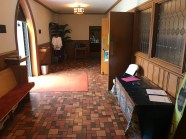 The NARTHEX, or vestibule, is entered by the main entrance stretching across the entire end of the church and prepares the worshiper for entering the sanctuary, separating him from the hustle and bustle of the material world, readying him for the quiet of the House of Worship. The NAVE is from the Latin word “navis”, which means ship. The earliest symbolism
 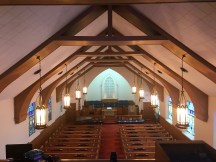 associated with the church is that of a Ship. It returns us to the ark, and the church in comparison is the “ark of safety.” It was natural that the early church buildings were in the form of a ship. So today the nave is the central division of the church in which the congregation is seated.
 we approach the altar, we find at intervals ascending levels and steps leading upward until they reach the altar. We note that the carpet is somewhat worn, reminding us of the many persons who have walked this way —- young couples taking their marriage vows, members of the church family who have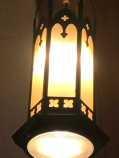
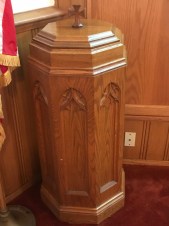 The BAPTISMAL FONT, Latin for “fountain,” is an octagonal receptacle of wood which stands on a pedestal and contains the water for baptism—outward sign of inner change. The cover of the font is crowned with the Cross Pate’e which if formed by four spearheads touching at the center. The eight outer points symbolize the eight Beatitudes and the regeneration of man. The PULPIT, Latin for “raised platform,” is used in delivering sermons. The LECTERN, the desk which stands opposite the pulpit, is usually smaller than the pulpit and used for reading the scripture.
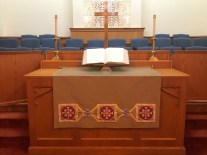 facing the congregation. It may be against the wall or free-standing. At the altar the Holy Communion is consecrated and administered and worship is conducted. Here the hangings, blue cross above the altar, the altar cross, and candles are placed. The HANGINGS, or frontals, are of fine cloth hung on the front of the altar, pulpit and lectern, depicting the divisions of the church year by their color.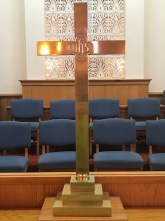
 revkevreflections