
 (Author’s note: This is the manuscript for my message on August 5, 2018 at FUMC Winnfield and is the ninth in my “Windows to the Soul” sermon series expounding on the Christian symbolism present in our church buildings and sanctuary windows at FUMC Winnfield. My sources are listed at the end. Much of this information is from “FUMC Winnfield: Christian Symbolism and History” published in 2012. I decided to publish in case some were absent and would like to read my message.)
I. Introduction
Over the last weeks we have been looking at the reminders of God all around in the symbolism of our church building and stained glass windows. Today we come to window number 8 in memory of Carolyn Sue Smith.
Carolyn Sue Smith was born March 23 1939 in Winnfield. She died Sep 6 1950 (aged 11) in Winnfield. She is buried in the Winnfield Cemetery.
Her obituary reads: Tragedy struck suddenly this week in Winnfield with the untimely death of Carolyn Sue Smith, 11 year old daughter of Mr. and Mrs. Troy Smith. Carolyn became very ill Tuesday afternoon at her father’s store, the Jitney Jungle supermarket, and was taken to a local hospital, where she died at 2:45 a.m. Wednesday.
Funeral services were conducted at the First Methodist Church with the pastor, Rev. P. M. Caraway, the former pastor, Rev. Fred S. Flurry, of Hammond,, and Rev. Alwin Stokes, officiating. The Methodist choir sang, “Lead, Kindly Light.”
Carolyn was born in Winnfield on March 23, 1939 and had lived here all her life. She was in the sixth grade in Winnfield School, where she was especially interested in science and math and did excellent work in this field. She was everyone’s friend, having a sweet disposition and a habit of being kind to everyone. Her classmates loved her and showed this by electing her to several positions of honor in her classes.
She was a member of the elementary chorus and the band at school, and was a member of the Girl Scouts. She was active in the Junior Department of the Methodist Church and was a member of the Methodist junior choir. Surviving, besides her parents, are one brother, Troy Lynn; her grandparents, Mr. and Mrs. F. O. Lattier, Winnfield, and Mr. and Mrs. J. L. Smith, Timpson, Texas.[i]
Carolyn was the sister of Troy Lynn Smith- Missy Smith’s husband. She had an Aneurysm upstairs at the store and died next day. Died Sept 6 on Missy’s birthday, whom she had just met. It was a tragedy that affected their family for many years to come. But even in her few years on this earth, she seems to have made a positive impact on those around her. We remember and celebrate her short life, as well as the beautiful gift of this window in her memory.
II. Body
A: Lyre
 The lyre again represents praise or worship. Psalms 33:2 reads, “Praise the Lord with the lyre, make melody to Him with the harp of ten strings!”
The lyre dates from before the Bronze Age (400-3200BC) and may have evolved from ancient harps. “The fundamental difference between a lyre and a harp, is that in a harp, the strings enter directly into the hollow body of the instrument, whereas on a lyre, the strings pass over a bridge, which transmits the vibrations of the strings to the body of the instrument – just as on a modern guitar.” Concerning the number of strings, each lyre varied in design. Typically there were three, four, seven and sometimes ten strings, each representing certain patterns of frequency (sound) considered appropriate in the design of the instrument i.e. meaning and purpose of the communication.[ii]
The ancient Hebrews had two stringed instruments, the “kinnor” (harp) and the “nebel” (lyre). In both instruments the strings were set in vibration by the fingers, or perhaps by a little stick, the plectrum (as Josephus says). The strings were made of gut, metal strings not being used in olden times. The body of the instrument was generally made of cypress (II Sam. vi. 5) or, in very precious instruments, of sandalwood (I Kings x. 11; A. V. “almug”).
The kinnor and nebel are often mentioned together. As in the case of all instrumental music among the Hebrews, they were used principally as an accompaniment to the voice. Instruments were used on joyous occasions, such as banquets and festive processions (Gen. xxxi. 27; I Sam. x. 5; II Sam. vi. 5; Isa. v. 12), and especially in the Temple service (Ps. xxxiii. 2, xliii. 4; Neh. xii. 27; I Chron. xvi. 5); here also in accompaniment to songs of praise and thanksgiving (I Chron. xvi. 16; II Chron. v. 12; Ps. xxxiii. 2, lvii. 9, lxxi. 22). They were never used on occasions of mourning (Isa. xxiv. 8; Ezek. xxvi. 13; Lam. v. 14; Ps. cxxxvii. 2; Job xxx. 31). The nebel, the lyre, seems to have been reserved exclusively for religious occasions (Amos v. 23; Ps. cxliv. 9). In connection with secular events (Amos vi. 5; Isa. xiv. 11), its use appears to have been regarded as unseemly and profane. It is evident from the Old Testament that the lyre could be played while the performer was walking (I Sam. x. 5; II Sam. vi. 5; Isa. xxiii. 16); hence they must have been easy to carry.[iii] The lyre reminds us of the joy of music and praising God through song.
B: Dove with Olive Branch and Noah’s Ark
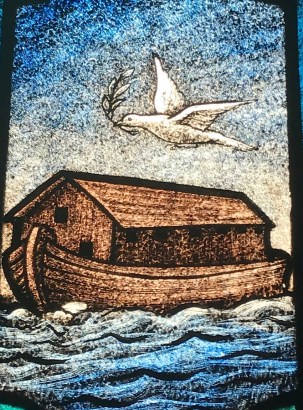 The dove with olive branch is a symbol of peace. When Noah’s ark is used, it stands for salvation or more particularly the salvation which the Church affords. Thus it is often used as a symbol of the Church.
We already examined the symbolism of the dove on two prior windows, so this morning I’m going to focus on what Noah’s Ark Represents. This morning we shall examine briefly certain aspects of the story of Noah’s ark and how it relates to Christ. If we fail to see Christ in the story of Noah’s ark, we miss the point. The image of Christ portrayed in the Ark offers many parallels.
-The ark was constructed of wood. The cross upon which Jesus died was constructed of wood.
-Noah was instructed to make a single door in the side of the Ark; it was the only entrance into the Ark, and access was controlled by God. Likewise, Jesus said that He is the door, and that no one comes to the Father except through Him.
-The Ark carried all of its passengers safely to the destination that God had prepared for them. Jesus said: I go to prepare a place for you. And if I go and prepare a place for you, I will come again, and receive you unto myself; that where I am, there ye may be also. (John 14:1-3)[iv]
-The word Noah means rest or comfort. Christ is our comfort and rest (Heb 4:4-11).
-Noah built the ark according to God’s revelation, not his own wisdom or imagination (Gen 6:15). This is symbolic of Christ and Christ’s workers, building the church according to God’s plan and not their own plan (Matt 16:18, John 6:38, 1 Cor 3:10-15, Eph 2:20-22).
-The dimensions of the ark was 300 cubits long, 50 cubits wide, and 30 cubits high (Gen 6:15). We lose the significance of these measurements when we translate them into English dimensions. The number 3 signifies the Trinity (Matt 28:19). The number 5 signifies the creation (four, Rev 4:6-9) plus God (one). 5 (four plus one) is creation in God, or strengthened creation. God created humans with 5 fingers, 5 toes and 5 senses (hear, see, smell, taste, touch).
-Like Christ, the ark was for the salvation of all living things, not just mankind (Col 1:20).[v] Pictures depicting the ark can even be found in the catacombs where the early Christians gathered.[vi] Noah was saved from the water, but through the waters of baptism we are saved. The dove with olive branch and Noah’s ark reminds us God’s salvation through the ark and through Jesus.
C: Lamb on book of seven Seals
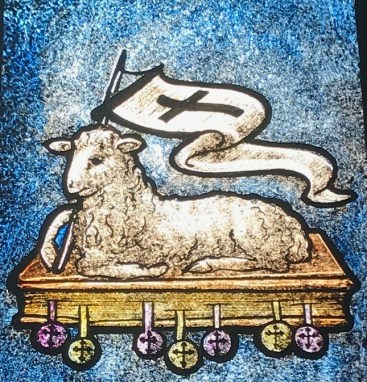 According to John 1:29, when John the Baptist saw Jesus, he said, “Behold, the Lamb of God.” This and a similar statement in John 1:36 have brought into being two of our most meaningful symbols of Jesus Christ. One form of this symbol shows a lamb reclining on the Book of the Seven Seals mentioned in Rev. 5:1. The Easter banner symbolizes Christ’s victory over death.
The lamb represents Jesus. A lamb summed up all the sacrifices of the Old Testament. A lamb was described it as “the theological shorthand for all the sacrifices of the Old Testament.” This lamb showed the evidence of having been killed, yet it was alive! Here is Jesus, the One spoken of in prophecy; He is a man, yet sinless; He has been crucified and has been resurrected! Death could not hold Him! He is worthy to break the seals and shower blessings upon the human race by redeeming it. A lamb is the epitome of weakness. As the Lamb of God, Jesus portrayed perfect weakness – He did nothing in His own power; He remained on the cross and died for His enemies!
What do the seals signify? Only the Lamb, whose very life has overcome death, is worthy to open the seals and to redeem humanity. [vii] This seems to be an appropriate end to the windows ringing our sanctuary, for this window panel, more than any other, looks toward the victorious second coming of Christ when the lamb shall become the lion of Judah. The lamb reminds us of the sacrifice of Jesus and that he is coming again.
III. Conclusion
We love our stained glass windows and we should. But what do people see in us? Does the light of Christ shine through us? The lyre reminds us of the gift of music and the songs of praise to the Lord. The dove and Noah’s ark remind us of God’s salvation through Noah and Jesus. The lamb and the seven seals remind us of Jesus’ sacrifice and the day when he will return. The short life of Carolyn Sue Smith reminds us that there are no guarantees in life and that we can impact lives in only a few short years. The question is will we allow the light of God to shine through us as brightly as it does these windows?
[i] https://www.findagrave.com/memorial/59211940/carolyn-sue-smith
[ii] https://designconsciousness.blogspot.com/2017/01/the-significance-of-lyre.html
[iii] http://www.jewishencyclopedia.com/articles/7266-harp-and-lyre
[iv] http://www.icr.edu/what-noahs-ark-represents
[v] https://www.talkjesus.com/threads/the-significance-of-noahs-ark.49679/
[vi] https://earlychurchhistory.org/christian-symbols/the-deluge-as-a-biblical-symbol/
 (Author’s note: This is the manuscript for my message on July 29, 2018 at FUMC Winnfield and is the eighth in my “Windows to the Soul” sermon series expounding on the Christian symbolism present in our church buildings and sanctuary windows at FUMC Winnfield. My sources are listed at the end. Much of this information is from “FUMC Winnfield: Christian Symbolism and History” published in 2012. I decided to publish in case some were absent and would like to read my message.)
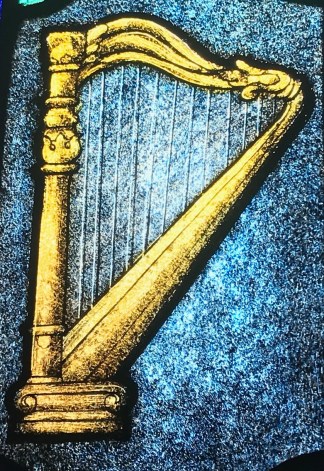 The harp signifies heavenly joy and the music of David. (Psalms 150). Throughout the Old Testament we learn of praises made with musical instruments and today music is very important in our worship services.
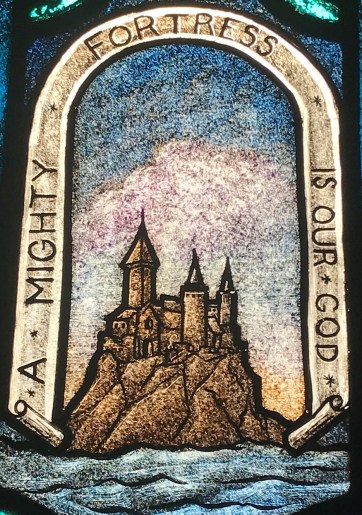 A house or church on a rock is sometimes pictured as securely founded, like those who hear the word of our Lord and do them (Matt. 7:24) and confess him as the Son of the living God-—the rock of faith against which the gates of hell shall not prevail (Matt. 16).
 The trumpets are a call to worship and remind us of the Day of Judgment and the Resurrection. They, too, are used in praise. The words, “Ye Praise The Lord,” reflect this symbolism
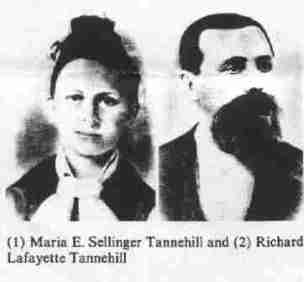 Marie Elizabeth Sellinger Tannehill was Born Jan 3 1859 DEATH Jan 4 1891 (aged 32) BURIAL Jerusalem Cemetery on Hwy 84 west of Winnfield. She was married to Richard Lafayette Tannehill who was said to be a large man (over 6 foot 4 inches) and was a farmer, timberman and politician north of Winnfield. The Winn Parish history book reports that Richard was the Sheriff of Winn Parish from 1874 to 1884. In 1892, he ran for Governor of Louisiana on the Populist ticket and won Winn Parish with 1,001 votes. He was the first elected mayor of Winnfield in 1898. Elizabeth and Richard had 8 children: George Milton Tannehill 1877–1940, Herbert N Tannehill 1879–1961, Clarence Eugene Tannehill 1881–1963, Richard Lafayette Tannehill 1884–1929, Ena Tannehill 1886–1895, Lena Tannehill Pace 1886–1976, Elizabeth Tannehill Walsh 1888–1977, Ella May Tannehill Hardtner 1890–1980. Their 7th child, Elizabeth Tannehill Walsh, often called Bessie, was Don Walsh’s grandmother. The only known relatives of Elizabeth Tannehill active in our church is Don’s widow, Shirley Walsh.
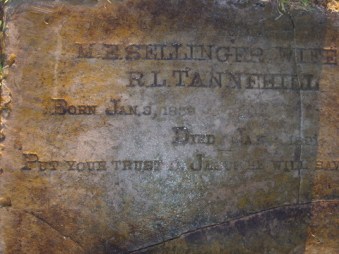 As I was doing my research I wondered why Elizabeth was buried west of town while Lula and Richard are buried in the Winnfield Cemetery. Donovan Hearne Walsh writes this on genealogy.com. “Richard Lafayette’s parents (David & Nancy) came to Winn Parish with them. Three sons died at Tannehill, as did Nancy, and were buried there. Later, the cemetery was moved to Jerusalem Cemetery at the request of the area’s first railroad (Arkansas railroad, later Rock Island RR). At that time period the public wanted railroad transport desperately and accommodated their wishes. These graves were put in one grave marked “Grandmother.” A Nancy M. T. marker was added later. R. L. Tannehill made this move and his remaining brother, Louis Monroe T., objected causing a large disagreement. :.M.T. is buried at Winnfield Cemetery, as is R.L.T. -Donovan Hearne Walsh
 Jesus said, “I am the bread of life.” Heads of wheat symbolize bread, and the Holy Communion. Also the wheat represents the good crop, the faithful, and the tares are the weeds, the wicked. (Matt. 13).
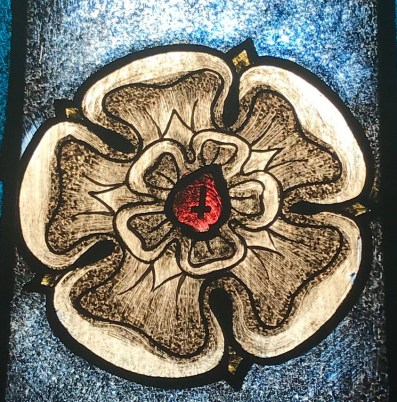 The Christmas Rose represents the Nativity of our Lord. Deep significance is derived from its survival through the centuries’ in spite of snow and storms. It blooms just at Christmas time.
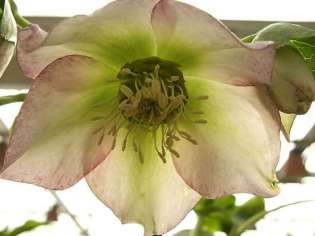 a little Sheppard named Madelon. As Madelon tended to her sheep one cold and wintry night, Wise Men and shepherds passed by Madelon’s snow-covered field bearing gifts for the Christ Child. Following, Madelon saw the Magi present gold, myrrh and frankincense to the baby…even the humble shepherds had brought fruits, honey and doves to give to the babe…but Madelon had nothing, not even a simple flower for the Newborn King. Standing outside the stable where Jesus had been born, poor Madelon wept, wishing that she had a gift she could carry to the infant. A watching Angel, taking pity on Madelon, caused the snow at the feet of the small girl feet to vanish, thus revealing a most beautiful white flower whose petals were tipped with pink, formed by the Angel from the tears which had fallen from the eyes of the little shepherdess. Overjoyed, Madelon presented her gift at the manger of the baby Jesus…her gift of the Christmas Rose.
 The Calvary Cross with the steps of Faith, Hope and Charity is also called the graded cross. The anchor at the left is a symbol of hope “sure and steadfast” (Heb. 6:19). The Bible is again pictured with the Cross. Two other books in the Protestant church call sacred associations to mind—the hymnal and The Book of Worship.
 (Author’s note: This is the manuscript for my message on July 15, 2018 at FUMC Winnfield and is the sixth in my “Windows to the Soul” sermon series expounding on the Christian symbolism present in our church buildings and sanctuary windows at FUMC Winnfield. My sources are listed at the end. Much of this information is from “FUMC Winnfield: Christian Symbolism and History” published in 2012. I decided to publish in case some were absent and would like to read my message.)
 The entire community mourns the passing of Andrew Jackson Gwin, for twenty one years one of the foremost enterprising citizens of Winnfield, died on January 31, 1927 at his home on Main Street. Though Mr. Gwin had been suffering with heart trouble for more than a year, he had not been critically ill for more than thirty days and his death Monday morning while not unexpected was a distinct shock to the entire town because of the high esteem in which he is held.
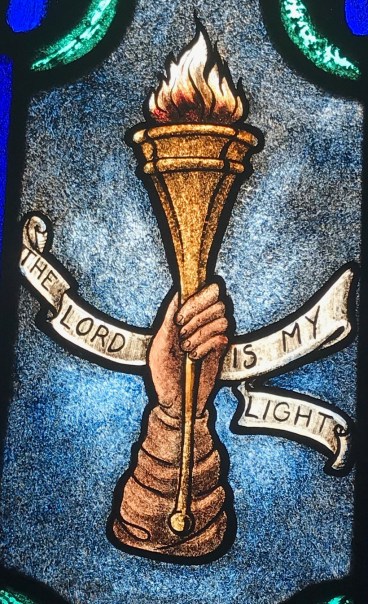 The torch refers to youth’s relation to the past and its obligation to bear the light of truth through the current age to the coming age. “The Lord Is My Light and My Salvation, Whom shall 1 fear?” Psalms 27:1. Jesus said, “I am the light of the world; he who follows me will not walk in darkness, but will have the light of life.” John 8:12.
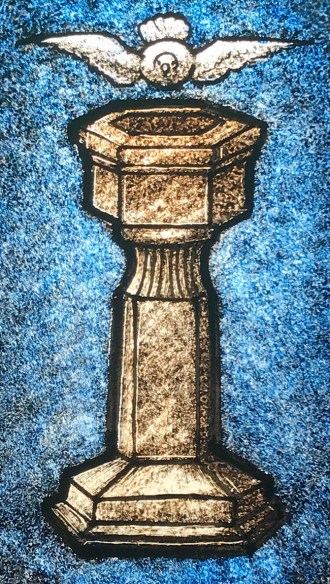 The font is pictured again with the dove of the Holy Spirit lending emphasis to our belief in the two sacraments: Holy Communion and Baptism. Jesus also told his followers to be “innocent as doves” (Matt. 10:16).
 The accessibility to the Bible since the days of the Reformation leads to its being shown open. The Lamp of Learning recalls the scripture, “Thy word is a lamp to my feet and a light to my path.” (Psalms 119:105). To the ancients a lamp was not merely a light for darkness, but also a symbol of intelligence and learning. Today it means wisdom and knowledge.
 (Author’s note: This is the manuscript for my message on July 8, 2018 at FUMC Winnfield and is the fifth in my “Windows to the Soul” sermon series expounding on the Christian symbolism present in our church buildings and sanctuary windows at FUMC Winnfield. My sources are listed at the end. Much of this information is from “FUMC Winnfield: Christian Symbolism and History” published in 2012. I decided to publish in case some were absent and would like to read my message.)
 Today we will focus on Window Number four in honor of Dr. and Mrs F.C. Wren. Funeral services for Dr. Floyd Carr Wren, prominent retired dentist and civic leader, were held at 3 p.m. Friday, February 10, 1967 in the First Methodist Church of Winnfield with the Rev. Richard Walton, pastor, officiating. He was assisted by Rev. Fred Flurry, Sr., and the Rev. R. H. Staples, former pastors. Dr. Wren died at 12:20 p.m. Thursday, February 9, 1967, in a Winnfield hospital following an apparent heart attack. He was 87.
 Funeral services for Mrs. Leta O. Wren, 87, of Winnfield, were held at 3:30 p.m. Friday, June 5, 1970 at the First Methodist Church of Winnfield with Rev. J. C. Skinner and Rev. Robert Gage officiating. Mrs Wren died at 11:15 a.m. Thursday, June 4, 1970, in a Winnfield hospital. She was a native of Caldwell, Ark., but lived in Tennessee during the early years of her life.
 The lion, as king of beasts, represents the royal character of Christ and refers to the opening verses of the Gospel in his reference to John the Baptist, “The voice of one crying in the wilderness . . .” The halo of light, the nimbus, behind the head denotes sanctity.
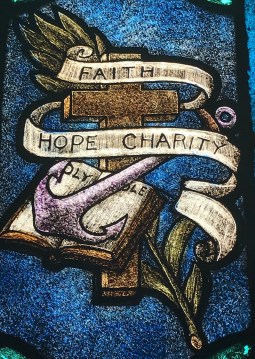 e, and Charity are referred to by Paul in I Cor. 13:13- “And now abideth faith, hope, charity, these three; but the greatest of these is charity.”KJV Faith is belief and trust in the triune God; Hope signifies our promise of eternal life and triumph of truth and justice; Charity, or love, is the center of our religion as taught by Jesus in many ways.
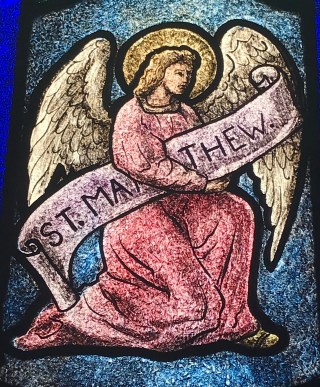 Matthew traced the human lineage of Jesus; therefore, the symbol used for him is a winged man. He emphasized the humanity of Christ. Here again is the nimbus of sanctity.
 (Author’s note: This is the manuscript for my message on July 1, 2018 at FUMC Winnfield and is the fourth in my “Windows to the Soul” sermon series expounding on the Christian symbolism present in our church buildings and sanctuary windows at FUMC Winnfield. My sources are listed at the end. Much of this information is from “FUMC Winnfield: Christian Symbolism and History” published in 2012. I decided to publish in case some were absent and would like to read my message.)
 His wife, Mary Margaret Jackson Dickerson died at 8 a.m. Tuesday, May 19, 1925, age 90 years. Mrs. Dickerson was born in Tennessee February 25th, 1835, moved in early childhood with her parents to Spanish Lake, Natchitoches Parish, where they lived until they moved to Winn Parish, La., in 1859.
 The dove with the olive branch depicts peace, victory, and the expectation of new life. This symbol comes from the account of the cessation of the flood recorded in Genesis 8:11 (Noah sent out the dove to see whether the flood was receding. When the dove returned with a “freshly plucked olive leaf” in her beak, Noah knew that the waters were receding). Hence the olive branch may be said to symbolize deliverance from the hardships of life and a peaceful life with God in the world to come.
 The Bible and the Cross go hand in hand—both represent knowledge of God’s redeeming love. Bible is Greek for “book” and is accepted by Christians as inspired by God with the divine authority on which the Christian religion is based. With 39 Old Testament books, 27 New Testament, it has been called the window through which we see God and the mirror that reflects our true selves. The cross is the focal point of the Bible—everything before Christ set the stage for His coming; the deeds thereafter pay tribute to His power on earth. We spoke extensively about the Bible in the Hyde window. I will focus on the cross this morning
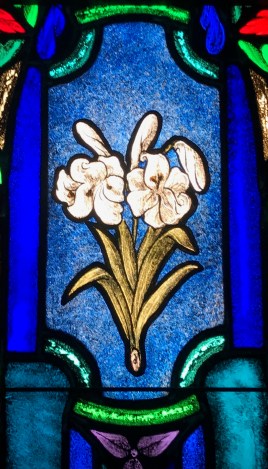 No specific scriptural justification is found for using the Easter Lily but it does aptly describe our hope in the resurrection. When the bulb is buried in the earth, a rebirth comes forth in the beauty of these white lilies with a new bulb for future”
 (Author’s note: This is the manuscript for my message on June 24, 2018 at FUMC Winnfield and is the third in my “Windows to the Soul” sermon series expounding on the Christian symbolism present in our church buildings and sanctuary windows at FUMC Winnfield. I tried to include my sources but my end notes did not transfer well. You’ll find the sources listed at the end. Much of this information is from “FUMC Winnfield: Christian Symbolism and History” published in 2012. I decided to publish in case some were absent and would like to read my message.)
 Formerly considered to be the Apostle John, he is like an eagle soaring to the Throne of Grace. Reference to the eagle is found in Rev. 4:6-8, and Ezek. 1:10.
 “The baptismal font is a vital part of the furnishings of the sanctuary. If the font has seven sides, it represents creation; eight symbolizes the new creation-—regeneration; a circular font indicates the beginning of eternal salvation. A quadrilateral shape speaks silently of people coming from four directions. It is seen on stained glass windows as a symbol of the regeneration of man.”
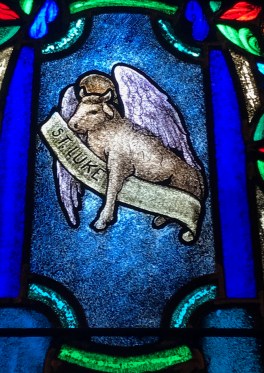 “The winged ox is a symbol of patience and service. The ox is used for St. Luke because he points out the atoning sacrifice of Christ, beginning with the sacrifice of Zachariah in the temple in chapter 1. Luke was the devoted physician of Paul who wrote the gospel of Luke, the book of Acts.” The ox is also a symbol of sacrifice, service and strength.
 (Author’s note: This is the manuscript for my message on June 10, 2018 at FUMC Winnfield and is the second in my “Windows to the Soul” sermon series expounding on the Christian symbolism present in our church buildings and sanctuary windows at FUMC Winnfield. I tried to include my sources but my end notes did not transfer well. You’ll find the sources listed at the end. Much of this information is from “FUMC Winnfield: Christian Symbolism and History” published in 2012. I decided to publish in case some were absent and would like to read my message.)
 building is window number ten, the lovely portrait of Jesus, the Good Shepherd.
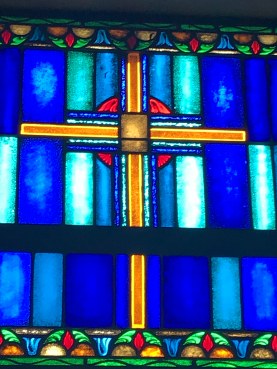
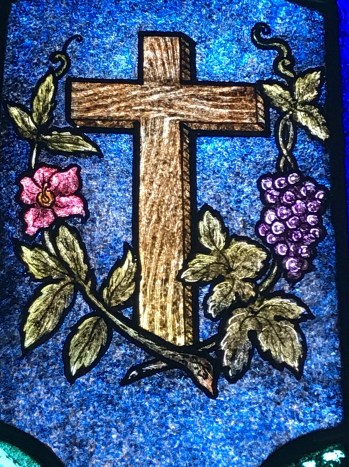 “The Latin cross is the most commonly seen cross. This is the form on which it is said our Lord was crucified. Protestants usually display it as being empty, without the body of Christ, representing Him as the risen and living Christ. The vine is referred to by Christ in John 15:5, ‘I am the vine, you are the branches.’”
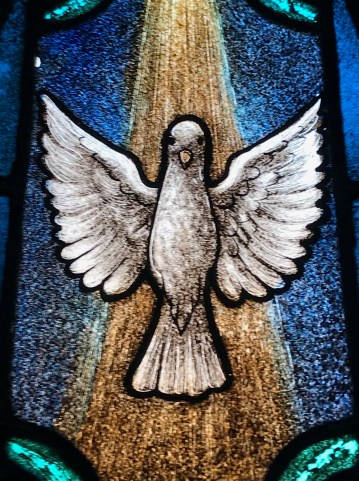 The Dove is the symbol of the Holy Spirit. In all four gospels it is recorded that the Holy Spirit came as a dove from Heaven, making it the most widely recognized symbol of the Spirit. The dove has long been a symbol of peace but the dove has great symbolism in the Bible too. It is mentioned 46 times in Scripture. In addition to its symbolism for the Holy Spirit, the dove was a popular Christian symbol before the cross rose to prominence in the fourth century.
 “The open book often pictured on stained glass windows in the church refers to the Holy Bible. the word of God. The book shown open indicates that the Bible is accessible throughout most of the world in over 1,000 tongues. The Easter Lily, a symbol of purity, is a common symbol of Easter and blooms at that time of the year.” We will look more closely at the symbolism of the Easter Lily in the Dickerson window, so this morning I’m going to focus on the Bible.
 (Author’s note: This is the complete manuscript and powerpoint pictures for my message at FUMC Winnfield on June 3. This is message #1 of my sermon series “Windows to the Soul” about the church building and stained glass windows at FUMC Winnfield. Much of this information is from “FUMC Winnfield: Christian Symbolism and History” published in 2012. I decided to publish in case some were absent and would like to read my message.)
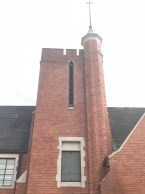 The CHURCH BELLS convey an inner meaning, calling worshipers to come and give the worship and adoration that are due God. The STEEPLE or spire, pointing toward the blue of Heaven, is a silent witness to the one true God whom the people come to worship in the church. Our steeple culminates in the cross at the top, signifying that God loves the world and is reconciling the world unto Himself through the worship, meditation, prayers, and hymns of the people in the church below.
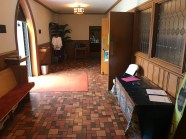 The NARTHEX, or vestibule, is entered by the main entrance stretching across the entire end of the church and prepares the worshiper for entering the sanctuary, separating him from the hustle and bustle of the material world, readying him for the quiet of the House of Worship. The NAVE is from the Latin word “navis”, which means ship. The earliest symbolism
 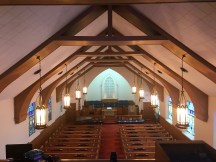 associated with the church is that of a Ship. It returns us to the ark, and the church in comparison is the “ark of safety.” It was natural that the early church buildings were in the form of a ship. So today the nave is the central division of the church in which the congregation is seated.
 we approach the altar, we find at intervals ascending levels and steps leading upward until they reach the altar. We note that the carpet is somewhat worn, reminding us of the many persons who have walked this way —- young couples taking their marriage vows, members of the church family who have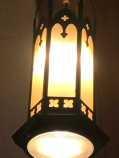
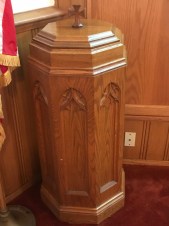 The BAPTISMAL FONT, Latin for “fountain,” is an octagonal receptacle of wood which stands on a pedestal and contains the water for baptism—outward sign of inner change. The cover of the font is crowned with the Cross Pate’e which if formed by four spearheads touching at the center. The eight outer points symbolize the eight Beatitudes and the regeneration of man. The PULPIT, Latin for “raised platform,” is used in delivering sermons. The LECTERN, the desk which stands opposite the pulpit, is usually smaller than the pulpit and used for reading the scripture.
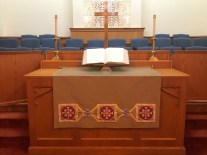 facing the congregation. It may be against the wall or free-standing. At the altar the Holy Communion is consecrated and administered and worship is conducted. Here the hangings, blue cross above the altar, the altar cross, and candles are placed. The HANGINGS, or frontals, are of fine cloth hung on the front of the altar, pulpit and lectern, depicting the divisions of the church year by their color.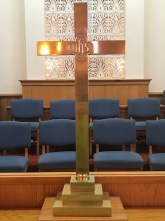
 revkevreflections